
Sharpen your voice. Strengthen your message.

Explore preaching tips, sermon insights, and biblical reflections from voices shaped by Great Lakes Christian College’s mission.

Some pastors close out the year with an elaborate written review—pages of reflection, goals, and
spiritual inventory. Chris VandeLinde is not one of those pastors. By his own admission, his
December plan is Christmas Eve, a nap, family, and a lot of sweets. I respect the honesty.

But this past January, Chris—Lead Pastor of Cornerstone Christian Church in Shiloh, Illinois,
and my guest on this week’s Better Preaching Podcast—sat down and prayed a dangerous prayer:
“Lord, how do you need me to lead differently this year?” He’d just taken some hits in December,
the kind that felt personal and unfair, arriving right through the vulnerable chinks in his armor.
The enemy has good aim.

What God gave him fits on a sticky note, which is still stuck to his desk: thicker skin, softer
heart, tighter lips.

Thicker skin. You signed up for this when you said yes to leading a movement that calls
suffering gain. You cannot let an emotional attack from someone with no investment in your life
cost you two days of ministry. Be Elijah on Mount Carmel, not Elijah whimpering under the
broom tree.

Softer heart. Here’s the trap: thicker skin tends to harden the heart right along with it. Chris
insists those two must never run parallel. As the skin toughens, the heart should be softening
toward the broken, the hurting, and the far-from-God. Even the people pushing hardest against
you aren’t your enemy. God’s got a plan for them too. Ezekiel says He replaces hearts of stone
with hearts of flesh. That surgery is ongoing.

Tighter lips. Chris is a verbal processor. His words, though thirty minutes of conversation
confirmed it. God’s correction was simple: some things you work out with Me, not with an
audience. Not every frustration needs to be shared. Some prayers are meant to stay prayers.

I told Chris this sounds like the title of his first book, and I’m only half joking. It preaches.
Because most of us in ministry get the formula exactly backwards: thin skin that bruises at every
criticism, a hardening heart that keeps people at a distance, and loose lips that process every
wound out loud.

God’s order is better. Toughen up. Tender up. Hush up.

That’ll preach in 2026—and every year after.

Chris VandeLinde called his air conditioning company last week and spent four minutes talking to a robot before he figured it out. The only giveaway? The robot was a little slow.

Pretty soon it won’t be.

Chris is the Lead Pastor of Cornerstone Christian Church in Shiloh, Illinois, and my guest on this week’s Better Preaching Podcast. He’s no AI alarmist. He told me he uses it every day for research. But he sees something coming that every preacher ought to notice: we are rapidly approaching the day when we can’t trust anything we see or hear online. Was that video real? Did that person actually say that? Am I even talking to a person right now? (For the record, Chris wondered aloud whether he was talking to the real Frank Weller. I assured him I’m one of a kind, which my wife confirms with a sigh.)

Here’s the surprising part. Chris believes this erosion of digital trust is going to drive people back to the things they can know are real. Their neighbors. A circle of chairs. Prayer with actual people in an actual room. Paper Bibles.

And the data backs him up. While AI usage is going through the roof, paper Bible sales are climbing right alongside it. That’s not a coincidence. That’s a hunger. When everything on a screen can be faked, ink on a page starts to feel like solid ground.

Chris thinks we may be standing at the front edge of another golden age of preaching—live proclamation, in person, from a flesh-and-blood preacher people know and trust. I’ve been saying the same thing about Christian higher education. You can learn a lot from a YouTube video. You can ask a chatbot to explain Colossians. But you cannot outsource spiritual formation to a bot, any more than you can outsource physical fitness to a workout video. As Chris put it, at some point you’ve got to actually lift the weights.

Formation happens face to face. It always has. The digital world is about to remind us why.

So preacher, take heart. The very technology that seems to threaten your calling may be the thing that sends people back to your pews, hungry for something real.

That something real is the analog church.

Episode Summary:

In this episode, Dr. Frank Weller talks with Chris VandeLinde, Lead Pastor of Cornerstone Christian Church in Shiloh, Illinois, about preaching that builds culture and reaches the next generation. Chris explains why every sermon must answer questions people are actually asking—especially questions of identity—and why culture-shaping belongs in every message when the average family attends less than twice a month. He shares who taught him to preach, from his youth minister to the podcast preachers who pastored him from afar. A lifelong soccer player, Chris draws a surprising lesson from World Cup culture: the church holds a unifying identity far greater than any flag or team. The conversation closes with his prediction that as AI erodes trust in the digital world, the church will see a resurgence of the tangible: paper Bibles, small groups, and in-person gatherings.

For show notes:

Covenant Connections https://www.covenantconnections.life/

I made a promise on this week’s episode of the Better Preaching Podcast, and my mother raised
me to keep my promises. So here it is.


My guest was Ben Cachiaras, who has preached at Mountain Christian Church for nearly thirty
years. We covered a lot of ground including a Mother’s Day sermon featuring a live eagle that
landed on a chandelier and … well … blessed the congregation in a way nobody requested. Ben
no longer preaches with live birds. Some innovations don’t survive the third service.


But the thing I promised to share is far more useful than eagle wrangling. At Mountain, they use
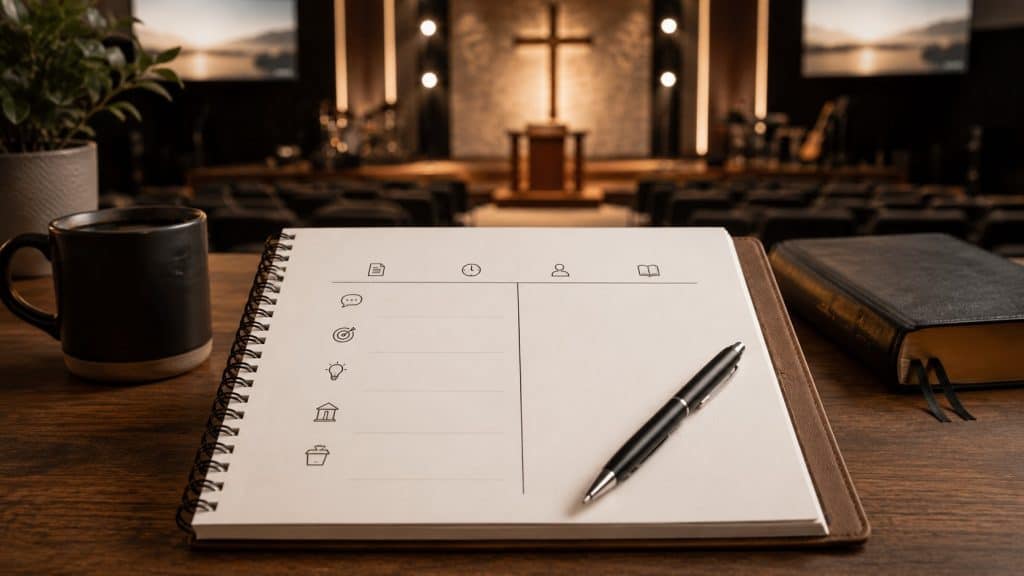
something called a T Doc—a simple planning document where every element starts with the
letter T. It forces the preacher to get clear about a sermon before the rest of the team has to guess.


Here are the T’s, as Ben described them:


Title — What are you calling it? (Mountain preached through Leviticus under the title “Hot
Mess, Holy God,” which is exactly the kind of title that makes me wish I’d thought of it first.)


Time — When is this sermon or series happening?


Talker — Who’s preaching?


Text — Where is this anchored biblically? You may touch several passages, but where’s home
base?


Topic — Is there a specific topic the sermon is addressing?


Theme — In a word or short phrase, what is this about? Repentance? God’s love? Salvation?


Theological concept — A little more room to breathe here. Is this sermon a pat on the back or a
kick in the shorts? Are we afflicting the comfortable or comforting the afflicted?


Takeaway — The big one. In a single sentence, what do we hope people will think, feel, or do
when they walk out?


Why bother? Because, as Ben put it, preaching is an event—and events take a team. When small
groups study alongside the sermon, their leaders need to prepare weeks in advance. When
worship planners are choosing songs, they need to know whether this message lands soft or lands
hard. A T Doc turns the preacher’s fuzzy intentions into something the whole church can build
around.


But here’s the sneaky benefit: the T Doc is a gift to the preacher first. If you can’t fill in the
takeaway line—if you can’t say in one sentence what you’re asking people to think, feel, or
do—you don’t have a sermon yet. You have a pile of notes.


So steal it. Ben won’t mind. Build your own T Doc, hand it to your team, and watch what
happens when everybody’s pulling in the same direction.


Because better preaching makes a bigger impact.

I recently sat down with Ben Cachiaras for the Better Preaching Podcast. Ben has served Mountain Christian Church near Baltimore for thirty of its 201 years, and I wanted to hear how a kid from Rochester, Minnesota ended up giving his life to preaching.

He almost didn’t.

Rochester is home to the Mayo Clinic, and Ben grew up surrounded by doctors’ kids. He was bright. School came easily. Plenty of people told him medicine would be a noble path, and he was leaning that way. Then he went to church camp.

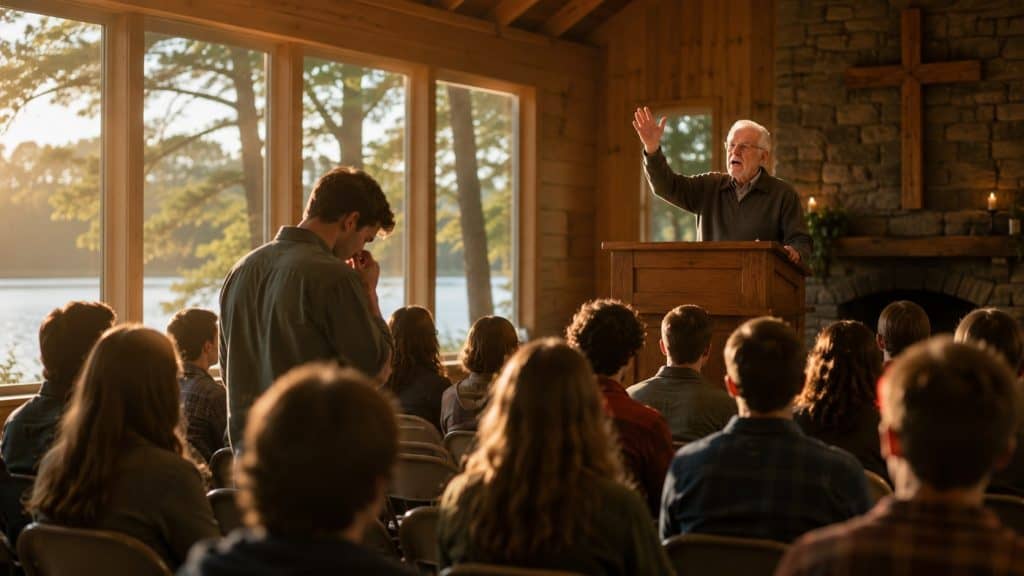
Pine Haven Christian Assembly sits on a Minnesota lake where Ben had been baptized years earlier. That weekend, the preacher in the hot little chapel was Ben’s grandfather—a Greek immigrant who came to Christ at Johnson Bible College in the early 1900s and served Minnesota Bible College from 1919 until his death in 1983. Picture it: folding chairs, restless high schoolers, and a nearly ninety-year-old man preaching with the passion of someone half his age.

At the end, he gave an invitation to salvation, and a couple of kids came forward. But he wasn’t finished. He issued a second call, for anyone willing to give the best energy of their life to serving the local church. To be a preacher. Then he added the line that undid his grandson: “If you think to yourself, ‘Yeah, I could probably do that,’ I’m not talking to you. I’m talking to the one who knows you can’t do anything else and have peace with God.”

Ben melted. He walked the aisle crying, stood beside his grandfather, and repeated a confession the old man composed on the spot. Med school was over before it started. He enrolled at Minnesota Bible College, and the trajectory of his life bent toward the pulpit for good.

Looking back, Ben suspects his grandfather knew exactly who was sitting in those folding chairs that day. I suspect he’s right.

Here’s what stayed with me. Ben said that moment makes him want to grab every seventh, eighth, and tenth grader, look them in the eye, and tell them it’s not too early to think about ministry. I grew up hearing my preacher say the best and brightest of our generation should go to Bible college and enter the ministry, the highest calling any of us can pursue.

Somewhere along the way, many of our churches went quiet on that. We tell our sharpest students to pursue engineering or medicine, and those are noble callings. But somebody has to say what Ben’s grandfather said.

Who’s the kid in your congregation waiting for a bold, clear call?

Say it. They may be listening harder than you think.

I recently had the opportunity to sit down with Dr. Daniel Overdorf, President of Johnson University and a professor of preaching for more than twenty years. As we talked about homiletics, sermon preparation, and the craft of preaching, I found myself reflecting on a question that every preacher should ask from time to time:

Have we forgotten the hard part of preaching?

Not the public speaking.

Not the illustrations.

Not the PowerPoint slides.

The hard part is immersing ourselves in the biblical text long enough for it to shape us before we ever attempt to shape a sermon.

Daniel described the temptation his students face. They are assigned a text, and almost immediately their minds jump to sermon ideas, outlines, illustrations, and applications. The impulse is understandable. Most of us have done the same thing.

But Daniel tells his students to resist that urge.

First, become an exegete.

Then, become a preacher.

That distinction struck me because I have seen the same tendency in my own preaching. Sometimes we become so focused on preparing a sermon that we neglect to study the Scripture from which the sermon should emerge.

When I taught homiletics, I told students to “roll around in the text like a bee rolls around in a flower until it’s covered with pollen.” The image may sound odd, but the principle is important. Stay in the text. Live in it. Wrestle with it. Let it challenge your assumptions and reshape your thinking.

Only then should you begin constructing a sermon.

The danger is that we develop what Haddon Robinson called the “one big idea” before we truly understand the passage. We decide what we want to say and then search the text for support. Good preaching works in the opposite direction. The text speaks first. The preacher responds.

Daniel emphasized something else I have come to appreciate more with age: clarity matters.

Creative preaching is valuable. Artistic preaching has its place. But if people leave wondering what you were trying to say, creativity has failed its purpose.

The most effective preachers I know can explain profound truths with remarkable clarity.

Finally, we talked about application. Not vague application. Specific application.

Don’t simply tell people to evangelize. Help them picture what faithfulness looks like when they walk into work on Monday morning, attend a family reunion next month, or sit down with a struggling friend.

People remember pictures more than abstractions.

Perhaps that’s why Jesus told so many stories.

I am convinced that the most powerful sermons I’ve heard were never the cleverest. They were the ones that emerged from a preacher who had spent enough time in the text to hear God’s voice before trying to amplify his own — and then applied what the text was saying in vivid pictures.

And maybe that’s the lesson many of us need to revisit.

The hard part of preaching is still the most important part.

Nobody warned Walter Neuenschwander that the panic was coming.
But somebody warned me. Early in my preaching life, a seasoned minister told a room full of young preachers that one day that, probably about a year into full-time ministry, you’re going to show up on a Monday morning and think you’ve got nothing left. You’ve preached everything you know. The cupboard is bare.
Walter heard the same warning in seminary. And by the grace of God, neither of us ever hit that wall. Here’s why: process.
The idea is simple, even if the discipline isn’t. Get six weeks ahead of your Sunday sermon. It starts with knowing your preaching calendar a year out. Then, when you’re six weeks from a given message, start writing. Put something on paper. Let it marinate. Then pick it up the week before you preach it, edit it, talk through it — literally out loud, multiple times — and then step into the pulpit.
That’s it. That’s the secret.
I know what you’re thinking. Six weeks ahead? That’s impossible. It felt that way to me once too. But here’s the advice that cracked it open for me, borrowed from Andy Stanley’s Communicating for a Change: don’t try to get six weeks ahead. Just try to get one week ahead. Write the sermon you plan to preach in two weeks first. Then write the sermon you plan to preach in two days. Do that for six weeks and suddenly you’re there.
And what you get on the other side is something preachers rarely talk about: your Saturdays back. Your family back. The margin to handle a funeral, a crisis, a season where life throws fifteen curveballs in three months, without your Sunday sermon being the thing that suffers.
Walter put it well. When you’re six weeks out, you’re not panicking. And when you’re not panicking, you’re not just surviving until Sunday. You’re actually thinking. Crafting. Letting a sermon breathe before you have to breathe life into it from a pulpit.
Ministry is a long game. The preachers who last are almost always the ones who learned to stop running behind and start running ahead.
Six weeks out is a great place to be.

Fuel your Preaching with Great Lakes Christian College