

Have We Forgotten the Hard Part of Preaching?

July 16, 2026

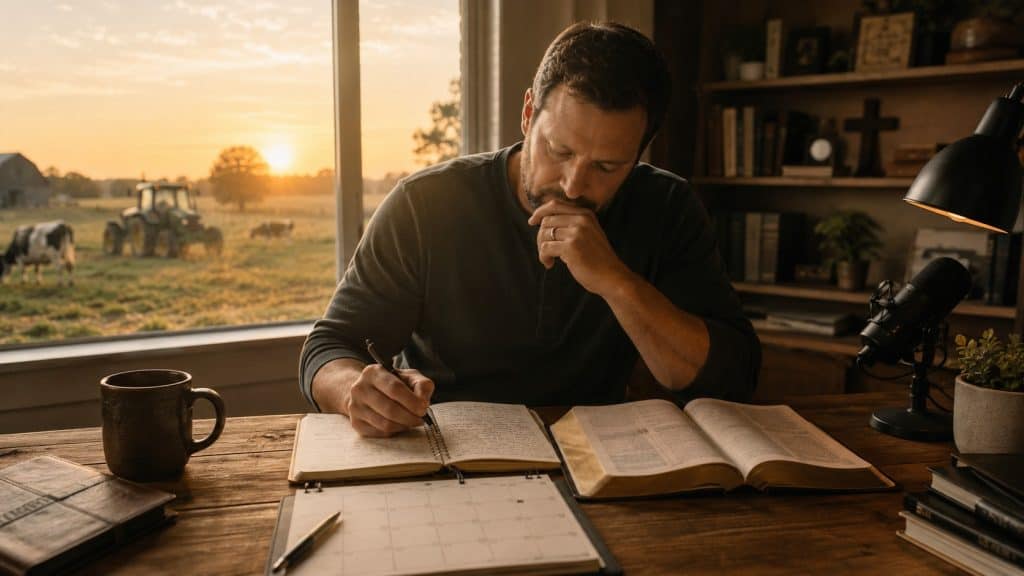
Open Bible, notebooks, and books on a wooden desk by a window.

I recently had the opportunity to sit down with Dr. Daniel Overdorf, President of Johnson University and a professor of preaching for more than twenty years. As we talked about homiletics, sermon preparation, and the craft of preaching, I found myself reflecting on a question that every preacher should ask from time to time:

Have we forgotten the hard part of preaching?

Not the public speaking.

Not the illustrations.

Not the PowerPoint slides.

The hard part is immersing ourselves in the biblical text long enough for it to shape us before we ever attempt to shape a sermon.

Daniel described the temptation his students face. They are assigned a text, and almost immediately their minds jump to sermon ideas, outlines, illustrations, and applications. The impulse is understandable. Most of us have done the same thing.

But Daniel tells his students to resist that urge.

First, become an exegete.

Then, become a preacher.

That distinction struck me because I have seen the same tendency in my own preaching. Sometimes we become so focused on preparing a sermon that we neglect to study the Scripture from which the sermon should emerge.

When I taught homiletics, I told students to “roll around in the text like a bee rolls around in a flower until it’s covered with pollen.” The image may sound odd, but the principle is important. Stay in the text. Live in it. Wrestle with it. Let it challenge your assumptions and reshape your thinking.

Only then should you begin constructing a sermon.

The danger is that we develop what Haddon Robinson called the “one big idea” before we truly understand the passage. We decide what we want to say and then search the text for support. Good preaching works in the opposite direction. The text speaks first. The preacher responds.

Daniel emphasized something else I have come to appreciate more with age: clarity matters.

Creative preaching is valuable. Artistic preaching has its place. But if people leave wondering what you were trying to say, creativity has failed its purpose.

The most effective preachers I know can explain profound truths with remarkable clarity.

Finally, we talked about application. Not vague application. Specific application.

Don’t simply tell people to evangelize. Help them picture what faithfulness looks like when they walk into work on Monday morning, attend a family reunion next month, or sit down with a struggling friend.

People remember pictures more than abstractions.

Perhaps that’s why Jesus told so many stories.

I am convinced that the most powerful sermons I’ve heard were never the cleverest. They were the ones that emerged from a preacher who had spent enough time in the text to hear God’s voice before trying to amplify his own — and then applied what the text was saying in vivid pictures.

And maybe that’s the lesson many of us need to revisit.

The hard part of preaching is still the most important part.

In 2006, Dave Stone stepped to the podium at the North American Christian Convention in Louisville, Kentucky. He had just become the lead minister at Southeast Christian Church following Bob Russell’s retirement, a transition that would have rattled most preachers into playing it safe. Stone didn’t play it safe. He preached from Ephesians 4 and asked a room full of church leaders a deceptively simple question: What is the greatest benefit of serving together?

He walked through three answers — unity, maturity, and testimony — and built the case that all three are real, but the last one matters most.

What makes this sermon worth revisiting nearly twenty years later isn’t the exegesis, though the exegesis is solid. It’s the storytelling. Stone understood something every preacher needs to learn: the right story doesn’t just illustrate the point. It becomes the point.

He told about his Uncle Greg, a quadriplegic with cerebral palsy, who went to a camp for developmentally challenged adults. A church member named John Miller volunteered as Greg’s counselor for four days, feeding him, dressing him, even rigging up a flotation device so Greg could swim for the first time in his life. At the end of the week, they asked Greg the standard question: What was your favorite part of camp? Greg raised his arm, pointed at John, and said one word: You.

That story does more theological work than a dozen propositional statements about humble service. And Stone knew it.

He closed with another story, this one from his own childhood. In 1967, his family was hit head-on by a hydroplaning car while on a trip in Illinois. His mother suffered a skull fracture. His father had twenty-one pieces of glass surgically removed from his eyes. Blind and alone in a strange town, the first visitor who took his father’s hand was an elder from a local Church of Christ. When Stone’s father mentioned that his congregation worshipped with instrumental music (a real fault line in the Restoration Movement) the elder said five words that carried the whole sermon home: That doesn’t matter. We just want to help a brother in Christ.

Stone admitted he’d forgotten that elder’s name. Then he landed the plane: I’ve forgotten the name on the back of his jersey, but I’m pretty certain what the name was on the front.

That’s how you close a sermon. You don’t explain the metaphor. You trust it.

Stone trusted it, and the room felt it.

Bob Russell will tell you himself that he isn’t a dynamic preacher. Once when he poke at a convention in Korea he thought himself bland in comparison to the more passionate Korean speakers. Hoping for a bit of encouragement he slid a note to his assistant. He slid it back with five words: “Just pep it up a little.” He didn’t, and couldn’t. Bible college students who heard him in chapel used to say, “If he can do it, we can do it too.”

That’s exactly why I wanted this message in our “Great Sermons of the Restoration Movement” series. Bob spent four decades proving that faithfulness outlasts flash, and in “Maximizing Your Preaching Gifts” he hands the rest of us five practical ways to get better.

Some of it is surprisingly earthy. Fix your lighting. Clear the clutter behind the pulpit. Set out fifty chairs, not seventy. Some of us have preached in rooms that were set up for optimism. Professional speakers told Bob the physical setting accounts for half of a talk’s effectiveness. Even if they’re exaggerating, that’s a lot of ground we’re giving away for free.

Then he gets to the heart of it. A golfer once told Bob there were only two things wrong with his game: distance and direction. Young preachers chase distance, the dazzling delivery. Seasoned preachers learn that direction, the content, wins over time. And content takes time. Lincoln didn’t write the Gettysburg Address on the train, and you won’t write Sunday’s sermon in a Saturday-night panic.

So, guard your study hours. Turn the phone off. Kill the adverbs. Apply the text with one-line examples before you go hunting for illustrations. Let your face show the joy your words describe. And be honest about your gifts. Rate yourself from one to ten, subtract two, and multiply by five, and that’s how many minutes you ought to preach. (I ran the numbers on myself. I’m not telling.)

Most of all, preach through books of the Bible. Bob’s wife Judy once sat through a Christmas sermon about the shepherds that never got back to the shepherds. Her verdict in the car is one I hope every one of us remembers: “What happened to the shepherds?”

The sermon ends at a Christmas brunch, where an entire family thanked Bob for preaching the gospel thirty-five years earlier. The children stood one by one to share when they were baptized. Bob walked to the car and told Judy, “Somebody was listening.”

Brothers and sisters, you can’t measure your effectiveness this Sunday. You may not see it for thirty-five years. Preach the Word anyway; your congregation are hungrier for it than you think. The harvest is God’s business.

Walter Neuenschwander didn’t want to be a preacher.

He wanted to drive a tractor. He wanted to take care of cows. And honestly? When he tells that story, something in it rings true for a lot of people who end up in ministry. The call came early and clear, and he ran from it anyway.

I got to sit down with Walter recently on the Better Preaching Podcast, and what struck me most wasn’t the dramatic Jonah moment where everything turned around (though that’s a great story, and you should listen to the episode). What struck me was something quieter. Something almost boring, in the best possible way.

When I asked Walter what advice he’d give to someone standing where he stood three or four years ago — preaching occasionally, not yet doing it week in and week out — he didn’t say anything flashy. He didn’t talk about charisma or delivery or finding your voice. He said: trust a routine.

Don’t be in a hurry. Start early. Plan ahead. Let the sermon breathe before you have to preach it.

That’s it. That’s the advice.

I’ve been around preaching my whole adult life, and I keep finding that the preachers who last,  the ones who grow, the ones whose congregations are genuinely fed week after week, they all have some version of this. A rhythm. A cadence. A way of living with the text before they have to stand in front of people and open their mouths.

Walter grew up sitting under Ron Fisher who, for decades, taught at Great Lakes Christian College and ministered at Northview Church of Christ. He was a legendary communicator who preached with one hand on the Bible and one hand on the newspaper. Fisher’s influence shaped a generation of ministers across mid-Michigan. And now Walter is doing the same thing at South Lansing Christian Church. Not because he set out to become a preacher, but because he finally stopped running.

God has a habit of doing that. Calling the reluctant. Developing the willing. And apparently, giving them a decent sermon routine in the process.