

I’m Talking to the One Who Knows You Can’t Do Anything Else.

July 23, 2026

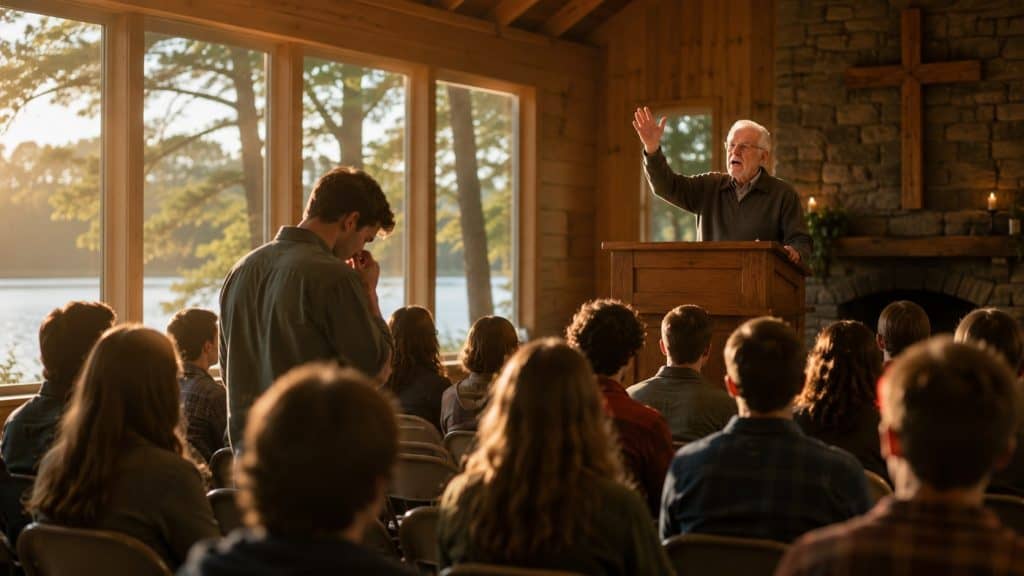
Speaker addressing audience in a cozy wooden room with large windows.

I recently sat down with Ben Cachiaras for the Better Preaching Podcast. Ben has served Mountain Christian Church near Baltimore for thirty of its 201 years, and I wanted to hear how a kid from Rochester, Minnesota ended up giving his life to preaching.

He almost didn’t.

Rochester is home to the Mayo Clinic, and Ben grew up surrounded by doctors’ kids. He was bright. School came easily. Plenty of people told him medicine would be a noble path, and he was leaning that way. Then he went to church camp.

Pine Haven Christian Assembly sits on a Minnesota lake where Ben had been baptized years earlier. That weekend, the preacher in the hot little chapel was Ben’s grandfather—a Greek immigrant who came to Christ at Johnson Bible College in the early 1900s and served Minnesota Bible College from 1919 until his death in 1983. Picture it: folding chairs, restless high schoolers, and a nearly ninety-year-old man preaching with the passion of someone half his age.

At the end, he gave an invitation to salvation, and a couple of kids came forward. But he wasn’t finished. He issued a second call, for anyone willing to give the best energy of their life to serving the local church. To be a preacher. Then he added the line that undid his grandson: “If you think to yourself, ‘Yeah, I could probably do that,’ I’m not talking to you. I’m talking to the one who knows you can’t do anything else and have peace with God.”

Ben melted. He walked the aisle crying, stood beside his grandfather, and repeated a confession the old man composed on the spot. Med school was over before it started. He enrolled at Minnesota Bible College, and the trajectory of his life bent toward the pulpit for good.

Looking back, Ben suspects his grandfather knew exactly who was sitting in those folding chairs that day. I suspect he’s right.

Here’s what stayed with me. Ben said that moment makes him want to grab every seventh, eighth, and tenth grader, look them in the eye, and tell them it’s not too early to think about ministry. I grew up hearing my preacher say the best and brightest of our generation should go to Bible college and enter the ministry, the highest calling any of us can pursue.

Somewhere along the way, many of our churches went quiet on that. We tell our sharpest students to pursue engineering or medicine, and those are noble callings. But somebody has to say what Ben’s grandfather said.

Who’s the kid in your congregation waiting for a bold, clear call?

Say it. They may be listening harder than you think.

Building Authentic Relationships for Deeper Impact

Effective preaching goes beyond delivering messages from the pulpit—it requires cultivating genuine relationships with the congregation. This is part two of a five-part series of posts that explore principles to help you preach contextualized sermons to people who are different than you.

This principle focuses on the importance of intentionally connecting as a generational immigrant so you can foster the trust and relatability that are necessary to increase the impact of your sermons.

The Challenge of Generational Distance

As pastors age, they can soon discover they are significantly older than many in their churches. Even when the congregation grows older with their pastor, the future of the church depends on it growing younger.

When there is a generational gap between the preacher and the congregation, it can inadvertently create barriers where younger parishioners feel misunderstood or distant from their pastors. The clergy–laity boundaries many practiced in the past can be off-putting for younger members.

What It Means to Intentionally Connect

Intentional connection means making an active effort to engage younger or older generational cohorts in ways that acknowledge their unique perspectives and needs.

It involves lowering traditional boundaries, being approachable, and demonstrating genuine care.

Practical Ways to Build Connection

Here is a truism: the more connected the congregation feels to their preacher, the more receptive they are likely to be to his preaching.

Here are four ways preachers can build connections that will result in more effective preaching:

  • Be accessible: Simple gestures like being visible in church lobbies or responding to social media interactions show availability and interest.
  • Share vulnerabilities: When pastors are appropriately transparent about their own struggles and failures, it builds authenticity and trust.
  • Engage beyond Sunday: Investing time in mentoring, attending social events, or hosting informal gatherings helps build deeper relationships.
  • Say “yes” more often: Affirming and encouraging younger generational cohorts by saying “yes” to prayer requests or meetings can have profound positive effects. The book Growing Young by Powell, Mulder, and Griffin is especially helpful on this point.

The Payoff of Connection

When younger Christians feel genuinely known and supported by their pastors, they are more open to hearing challenging biblical truths.

Relatability increases receptivity, making preaching a collaborative journey rather than a one-sided lecture.

Pastors need to remember that ministry is as much about being present and connected as it is about the content of sermons.

On a recent Better Preaching Podcast episode, I asked Mark Christian for his parting word to preachers. He didn’t hesitate: “Let the text win. Let it win in you. Stand underneath it before you ever stand behind the pulpit.”

I haven’t been able to shake that line.

Let’s be honest; most of us don’t approach the text to lose. But we do approach the text to mine it. We come armed with an outline, a sermon slot, a series title already on the church app, and we start interrogating the passage to get it to confess what we need it to say by Sunday. The text becomes a witness we’ve subpoenaed. We’re the attorney. We ask the questions. We decide which answers make the cut.

That’s not preaching. That’s prosecuting.

Letting the text win is a different posture entirely. It means showing up on Tuesday without a predetermined verdict. It means reading slowly enough so the text has time to read you back. It means allowing the passage to ruin your first three ideas before it gives you the right one. It means getting uncomfortable in your own conscience before you ever figure out how to make your congregation uncomfortable in theirs.

You can’t fake this. Your people can tell the difference between a preacher who has wrestled with the text and a preacher who has merely researched it. The wrestled preacher limps a little. There’s a weight in his voice that commentary software cannot manufacture. He isn’t delivering information. He’s delivering testimony.

Here’s the ordering Mark got exactly right: underneath, then behind. If you haven’t stood underneath the text all week, you have no business standing behind the pulpit on Sunday. The pulpit doesn’t confer authority on your words. The text does. And the text only confers that authority on preachers who have been willing, privately, to be defeated by it.

This week, let it win. Let it corner you. Let it convict you before it comforts your people. Let it strip you of the clever turn of phrase you already had written in the margin. Let it hand you a harder word than you were hoping for.

Then, and only then, stand up and preach.

Before he preaches, every preacher needs to ask: am I a generational native, or a generational immigrant? Each of us is naturally designed to preach to our own generational cohort. If you are a Gen X’er like me, you speak the language, you get the references. You are a native. But every other cohort? You might as well be a missionary in another country.

This five-part series of blog posts will explore five principles you can bring to your preaching that will more effectively help you communicate as a generational immigrant.

Preachers today face a cultural divide when communicating the timeless truths of the gospel to generations that are not their own. The first principle for effective preaching to a different generational cohort is to understand and embrace cultural differences by contextualizing sermons specifically for them.

Why Contextualization Matters

Contextualization bridges the gap between the biblical message and the lived experience of a particular culture or cohort. Scripture offers examples of this approach: both Peter and Paul adapted their messages to the cultural contexts of Jews and Gentiles.

Just as missionaries can communicate more effectively by immersing themselves in the culture to which they are called, preachers must study and understand the culture of different generational cohorts to connect meaningfully.

Understanding Context

Each generation is shaped by the experiences of their lifetime. Older generations may value stability, tradition, and loyalty. In contrast, younger generations often display skepticism toward institutions and authority figures, having been influenced by political controversies and religious scandals.

These realities shape their perceptions and their receptiveness (and resistance) to faith. Books like Generational IQ by Haydn Shaw and Engaging Generation Z by Tim McKnight can help.

Moving Beyond Assumptions

Preachers cannot assume their listeners share the same cultural reference points or spiritual background they do. The church no longer has a home-field advantage.

Today, preaching is an “away game,” requiring intentional effort to cross cultural and generational boundaries.

Practical Steps for Contextualizing

Here are four ways preachers can start to contextualize their preaching:

  • Learn listeners’ language and culture: Engage with their media, values, and experiences to understand what matters to them.
  • Be present: Spend time with people who are different than you—both in person and digitally—to build relationships and understanding.
  • Incorporate relevant illustrations: Your reference to that John Wayne movie might not connect. Use stories and examples that resonate with listeners’ context.
  • Address real-life challenges: Speak to the issues your listeners face, such as anxiety, financial pressure, delayed adulthood, or caring for aging parents.

By practicing contextualization, preachers can become cultural translators who make the gospel accessible, relevant, and transformative for everyone.