
You Can’t Outsource Your Soul to a Bot

August 6, 2026

Church gathering with AI technology and digital screens for sermon discussion.

Chris VandeLinde called his air conditioning company last week and spent four minutes talking to a robot before he figured it out. The only giveaway? The robot was a little slow.

Pretty soon it won’t be.

Chris is the Lead Pastor of Cornerstone Christian Church in Shiloh, Illinois, and my guest on this week’s Better Preaching Podcast. He’s no AI alarmist. He told me he uses it every day for research. But he sees something coming that every preacher ought to notice: we are rapidly approaching the day when we can’t trust anything we see or hear online. Was that video real? Did that person actually say that? Am I even talking to a person right now? (For the record, Chris wondered aloud whether he was talking to the real Frank Weller. I assured him I’m one of a kind, which my wife confirms with a sigh.)

Here’s the surprising part. Chris believes this erosion of digital trust is going to drive people back to the things they can know are real. Their neighbors. A circle of chairs. Prayer with actual people in an actual room. Paper Bibles.

And the data backs him up. While AI usage is going through the roof, paper Bible sales are climbing right alongside it. That’s not a coincidence. That’s a hunger. When everything on a screen can be faked, ink on a page starts to feel like solid ground.

Chris thinks we may be standing at the front edge of another golden age of preaching—live proclamation, in person, from a flesh-and-blood preacher people know and trust. I’ve been saying the same thing about Christian higher education. You can learn a lot from a YouTube video. You can ask a chatbot to explain Colossians. But you cannot outsource spiritual formation to a bot, any more than you can outsource physical fitness to a workout video. As Chris put it, at some point you’ve got to actually lift the weights.

Formation happens face to face. It always has. The digital world is about to remind us why.

So preacher, take heart. The very technology that seems to threaten your calling may be the thing that sends people back to your pews, hungry for something real.

That something real is the analog church.

Episode Summary:

In this episode, Dr. Frank Weller talks with Chris VandeLinde, Lead Pastor of Cornerstone Christian Church in Shiloh, Illinois, about preaching that builds culture and reaches the next generation. Chris explains why every sermon must answer questions people are actually asking—especially questions of identity—and why culture-shaping belongs in every message when the average family attends less than twice a month. He shares who taught him to preach, from his youth minister to the podcast preachers who pastored him from afar. A lifelong soccer player, Chris draws a surprising lesson from World Cup culture: the church holds a unifying identity far greater than any flag or team. The conversation closes with his prediction that as AI erodes trust in the digital world, the church will see a resurgence of the tangible: paper Bibles, small groups, and in-person gatherings.

For show notes:

Covenant Connections https://www.covenantconnections.life/

On a recent Better Preaching Podcast episode, I asked Mark Christian for his parting word to preachers. He didn’t hesitate: “Let the text win. Let it win in you. Stand underneath it before you ever stand behind the pulpit.”

I haven’t been able to shake that line.

Let’s be honest; most of us don’t approach the text to lose. But we do approach the text to mine it. We come armed with an outline, a sermon slot, a series title already on the church app, and we start interrogating the passage to get it to confess what we need it to say by Sunday. The text becomes a witness we’ve subpoenaed. We’re the attorney. We ask the questions. We decide which answers make the cut.

That’s not preaching. That’s prosecuting.

Letting the text win is a different posture entirely. It means showing up on Tuesday without a predetermined verdict. It means reading slowly enough so the text has time to read you back. It means allowing the passage to ruin your first three ideas before it gives you the right one. It means getting uncomfortable in your own conscience before you ever figure out how to make your congregation uncomfortable in theirs.

You can’t fake this. Your people can tell the difference between a preacher who has wrestled with the text and a preacher who has merely researched it. The wrestled preacher limps a little. There’s a weight in his voice that commentary software cannot manufacture. He isn’t delivering information. He’s delivering testimony.

Here’s the ordering Mark got exactly right: underneath, then behind. If you haven’t stood underneath the text all week, you have no business standing behind the pulpit on Sunday. The pulpit doesn’t confer authority on your words. The text does. And the text only confers that authority on preachers who have been willing, privately, to be defeated by it.

This week, let it win. Let it corner you. Let it convict you before it comforts your people. Let it strip you of the clever turn of phrase you already had written in the margin. Let it hand you a harder word than you were hoping for.

Then, and only then, stand up and preach.

Last week I had the privilege of sitting down with Dave Stone, and our conversation reminded me of something we desperately need to remember in this moment: artificial intelligence will never be able to do what a pastor can do.

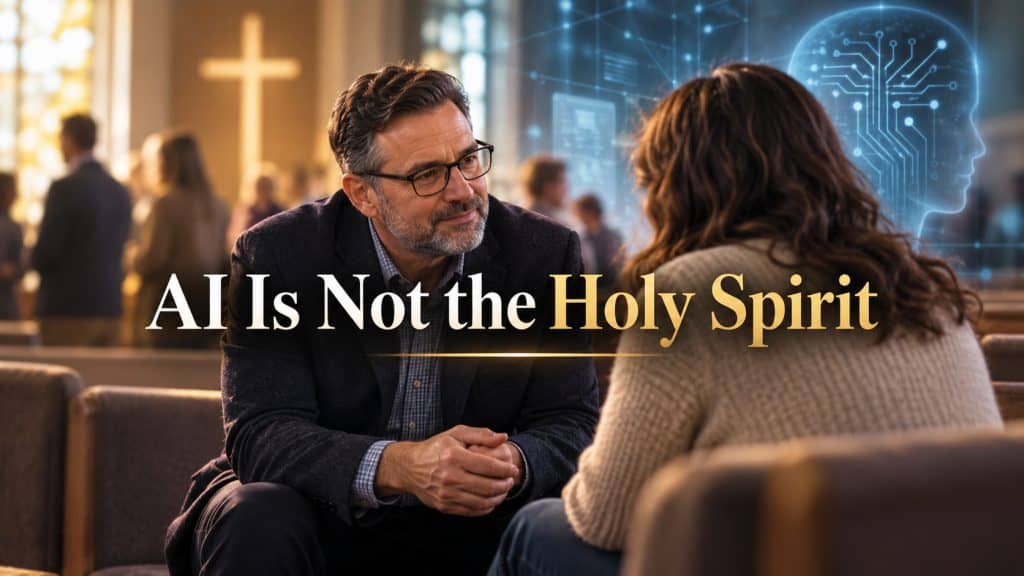
Dave shared something profound during our time together: “AI is not the Holy Spirit.” It sounds obvious when you say it out loud, but in a season when AI tools are proliferating faster than we can evaluate them, this statement cuts through all the noise. Yes, AI can help us edit our sermons. Yes, it can assist with wordsmithing and refining our language. But it cannot do the thing that makes preaching actually matter: it cannot connect a human soul with the living God.

This distinction became even clearer when Dave mentioned research showing that loneliness and companionship rank among the top uses of AI. Think about that. People are turning to artificial intelligence for what they should be finding in community. In the church. This isn’t a failure of AI; if anything, it is a misuse of AI. Dave’s warning is a clarion call for the church to lean into what we uniquely offer: genuine, Spirit-empowered presence.

At Great Lakes Christian College, we’ve built our entire institutional identity around this conviction. We know that spiritual formation cannot happen through a screen, no matter how sophisticated the technology. It happens when a student sits in a professor’s office and feels truly known. It happens when suitemates gather around someone who’s grieving and offer the kind of comfort that only the presence of another person can provide. It happens when a visiting speaker takes the time to learn students’ names and genuinely invests in their lives.

Dave spoke beautifully about something he did when he was Senior Minister of Southeast Christian Church. Dave would stand at the escalator to greet latecomers — not to shame them for showing up late, but to learn their names, to notice the visitor who feels out of place, to make the sanctuary feel smaller and more personal. He was describing something that AI could never replicate: the pastoral presence that says, “You matter. I see you. I know your name.”

The irony is that by distinguishing ourselves from AI, by leaning into what technology cannot do, we’re actually making our institutions and churches more relevant, not less. In a world drowning in information and connection-less connectivity, people are hungry for the real thing.

So yes, let’s use AI wisely. But let’s never mistake tools for transformation. Let’s never outsource spiritual formation to a machine. And let’s keep doing what only humans empowered by the Holy Spirit can do: see people, know their names, and love them into the Kingdom.

I’ve listened to a lot of sermons in my day, and most of them I forget by Tuesday. But every so often a preacher says one sentence that just lodges itself in your chest and won’t leave. Jeff Walling gave us one of those at the 2006 North American Christian Convention, and twenty years later it’s still rattling around in my head: “The time for being nice is over. It’s time to be family.”


Let that sit for a second.


Walling, an a cappella Church of Christ preacher, was standing in front of a room full of Christian Church folks — instruments, praise bands, the whole works — on the hundredth anniversary of the year our two branches of the Restoration Movement got listed as separate religious groups by the U.S. Census Bureau. A hundred years apart, and he had the nerve to say what a lot of us have thought but rarely said out loud: being polite to each other isn’t the finish line. It’s barely the starting block.


He told this story about getting invited to speak at an instrumental youth conference decades earlier. He discovered, after several increasingly awkward phone calls, that “instrumental Church of Christ” was in fact a real thing. That night he sat stone silent on stage while 3,000 teenagers worshiped with a guitar. And somewhere around minute fifteen, watching all that unashamed praise, he realized the problem wasn’t the guitar. It was his own attitude.


That’s the whole sermon in miniature, honestly. Grace doesn’t just save you. It humbles you, it makes you holy, and then it makes you do the hard work of loving people you’ve spent a career keeping at arm’s length. Walling put it more plainly than I could: “It is not duty that drives me to do good. It is how good God has been to me.”
And then — I still get a little misty thinking about this part — he called Dave Stone up on stage, both of them preacher’s kids who’d buried preacher fathers, and traded Bibles with him. Right there in front of everybody. College presidents, seminary heads, worship leaders, all swapping Bibles like it was nothing, when it was actually everything.


I don’t know about you, but I’ve been nice to plenty of people I had no intention of calling family. Walling’s sermon won’t let me get away with that anymore. Nice is easy. Family is a mess. His words, not mine, though I’ve certainly earned the right to borrow them.


You can listen to the whole sermon on The Better Preaching Podcast. And you should. It’s worth every minute.