

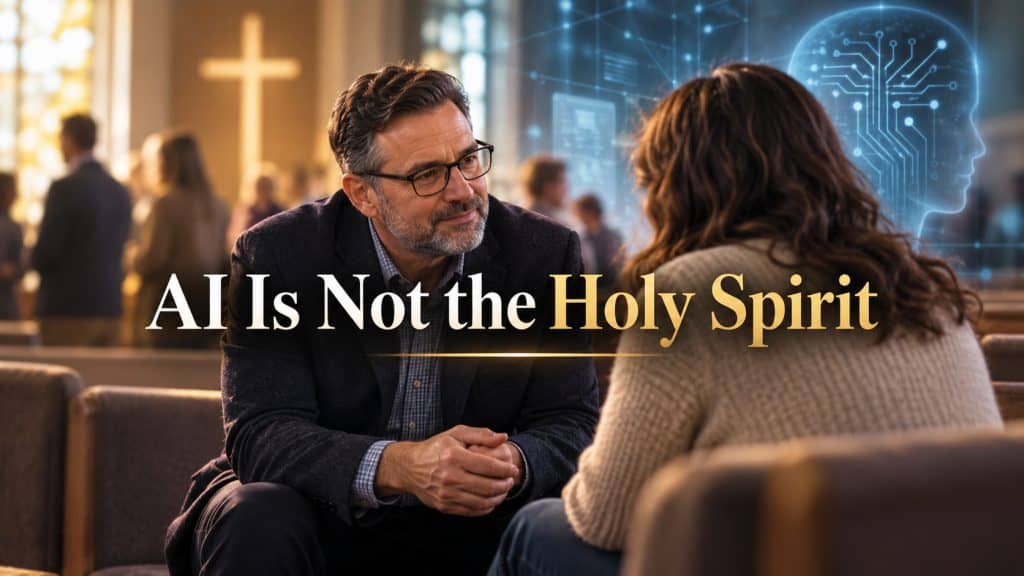
AI Is Not the Holy Spirit

September 24, 2026

Man and woman discussing faith and AI in church setting with digital brain overlay.

Last week I had the privilege of sitting down with Dave Stone, and our conversation reminded me of something we desperately need to remember in this moment: artificial intelligence will never be able to do what a pastor can do.

Dave shared something profound during our time together: “AI is not the Holy Spirit.” It sounds obvious when you say it out loud, but in a season when AI tools are proliferating faster than we can evaluate them, this statement cuts through all the noise. Yes, AI can help us edit our sermons. Yes, it can assist with wordsmithing and refining our language. But it cannot do the thing that makes preaching actually matter: it cannot connect a human soul with the living God.

This distinction became even clearer when Dave mentioned research showing that loneliness and companionship rank among the top uses of AI. Think about that. People are turning to artificial intelligence for what they should be finding in community. In the church. This isn’t a failure of AI; if anything, it is a misuse of AI. Dave’s warning is a clarion call for the church to lean into what we uniquely offer: genuine, Spirit-empowered presence.

At Great Lakes Christian College, we’ve built our entire institutional identity around this conviction. We know that spiritual formation cannot happen through a screen, no matter how sophisticated the technology. It happens when a student sits in a professor’s office and feels truly known. It happens when suitemates gather around someone who’s grieving and offer the kind of comfort that only the presence of another person can provide. It happens when a visiting speaker takes the time to learn students’ names and genuinely invests in their lives.

Dave spoke beautifully about something he did when he was Senior Minister of Southeast Christian Church. Dave would stand at the escalator to greet latecomers — not to shame them for showing up late, but to learn their names, to notice the visitor who feels out of place, to make the sanctuary feel smaller and more personal. He was describing something that AI could never replicate: the pastoral presence that says, “You matter. I see you. I know your name.”

The irony is that by distinguishing ourselves from AI, by leaning into what technology cannot do, we’re actually making our institutions and churches more relevant, not less. In a world drowning in information and connection-less connectivity, people are hungry for the real thing.

So yes, let’s use AI wisely. But let’s never mistake tools for transformation. Let’s never outsource spiritual formation to a machine. And let’s keep doing what only humans empowered by the Holy Spirit can do: see people, know their names, and love them into the Kingdom.

Chris VandeLinde called his air conditioning company last week and spent four minutes talking to a robot before he figured it out. The only giveaway? The robot was a little slow.

Pretty soon it won’t be.

Chris is the Lead Pastor of Cornerstone Christian Church in Shiloh, Illinois, and my guest on this week’s Better Preaching Podcast. He’s no AI alarmist. He told me he uses it every day for research. But he sees something coming that every preacher ought to notice: we are rapidly approaching the day when we can’t trust anything we see or hear online. Was that video real? Did that person actually say that? Am I even talking to a person right now? (For the record, Chris wondered aloud whether he was talking to the real Frank Weller. I assured him I’m one of a kind, which my wife confirms with a sigh.)

Here’s the surprising part. Chris believes this erosion of digital trust is going to drive people back to the things they can know are real. Their neighbors. A circle of chairs. Prayer with actual people in an actual room. Paper Bibles.

And the data backs him up. While AI usage is going through the roof, paper Bible sales are climbing right alongside it. That’s not a coincidence. That’s a hunger. When everything on a screen can be faked, ink on a page starts to feel like solid ground.

Chris thinks we may be standing at the front edge of another golden age of preaching—live proclamation, in person, from a flesh-and-blood preacher people know and trust. I’ve been saying the same thing about Christian higher education. You can learn a lot from a YouTube video. You can ask a chatbot to explain Colossians. But you cannot outsource spiritual formation to a bot, any more than you can outsource physical fitness to a workout video. As Chris put it, at some point you’ve got to actually lift the weights.

Formation happens face to face. It always has. The digital world is about to remind us why.

So preacher, take heart. The very technology that seems to threaten your calling may be the thing that sends people back to your pews, hungry for something real.

That something real is the analog church.

Episode Summary:

In this episode, Dr. Frank Weller talks with Chris VandeLinde, Lead Pastor of Cornerstone Christian Church in Shiloh, Illinois, about preaching that builds culture and reaches the next generation. Chris explains why every sermon must answer questions people are actually asking—especially questions of identity—and why culture-shaping belongs in every message when the average family attends less than twice a month. He shares who taught him to preach, from his youth minister to the podcast preachers who pastored him from afar. A lifelong soccer player, Chris draws a surprising lesson from World Cup culture: the church holds a unifying identity far greater than any flag or team. The conversation closes with his prediction that as AI erodes trust in the digital world, the church will see a resurgence of the tangible: paper Bibles, small groups, and in-person gatherings.

For show notes:

Covenant Connections https://www.covenantconnections.life/

Ben Merold walked into a bar to preach a sermon.

Not exactly how most homiletics professors would recommend you begin your ministry career. But there he was, pulpit replaced by a video machine, cocktail waitresses clattering around in the background. And when he got to the part about the Holy Spirit, everything went quiet. That’s Ben Merold for you. The Word had a way of showing up when he preached it.

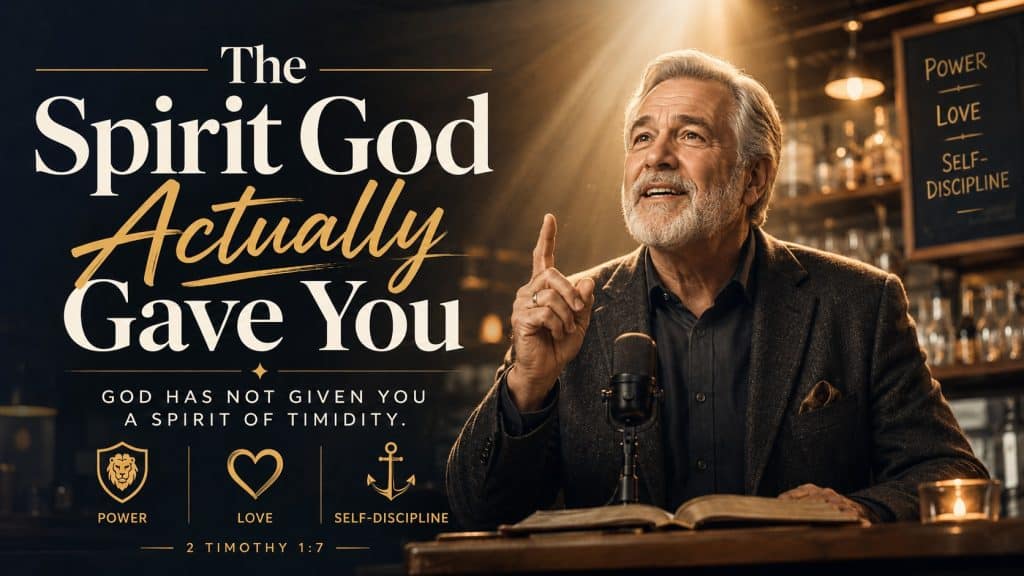
I’ve been sitting with a transcript of a sermon Merold preached at the Lincoln Christian College alumni reunion on March 14, 1985. His text was 2 Timothy 1:3-7, and his theme was simple and devastating all at once: God has not given you a spirit of timidity. Whatever that shrinking, fearful, draw-back spirit is that you’re carrying around — you didn’t get it from God.

So where did you get it?

Merold unpacked three things God does give. A spirit of power — not the horsepower kind, but the kind that changes a life, rewires a mind, repairs a relationship. A spirit of love — not the feeling-based, falls-in-and-out variety that fills up divorce court waiting rooms, but the committed, volitional, I’m-showing-up-regardless kind. And finally, a spirit of self-discipline — what Merold called, borrowing from one translation, a smiling mind. Quiet. Steady. Unintimidated by panic or passion.

What strikes me most about this sermon, forty years on, is how thoroughly Merold believed that the Christian life was supposed to be upbeat. He said it plainly: he looked around at Christianity and got a little disgusted at all the people who were down. Joy is fruit of the Spirit. God expects us to express it.

Ben Merold passed away in November 2022 at the age of 96. He grew two churches from under 200 to over 3,000. He held more than 500 revivals. He wanted to be remembered as a church builder and a friend of the small church.

But listening to him preach, what I remember most is that smiling mind.

God gave you that. 

Use it.