

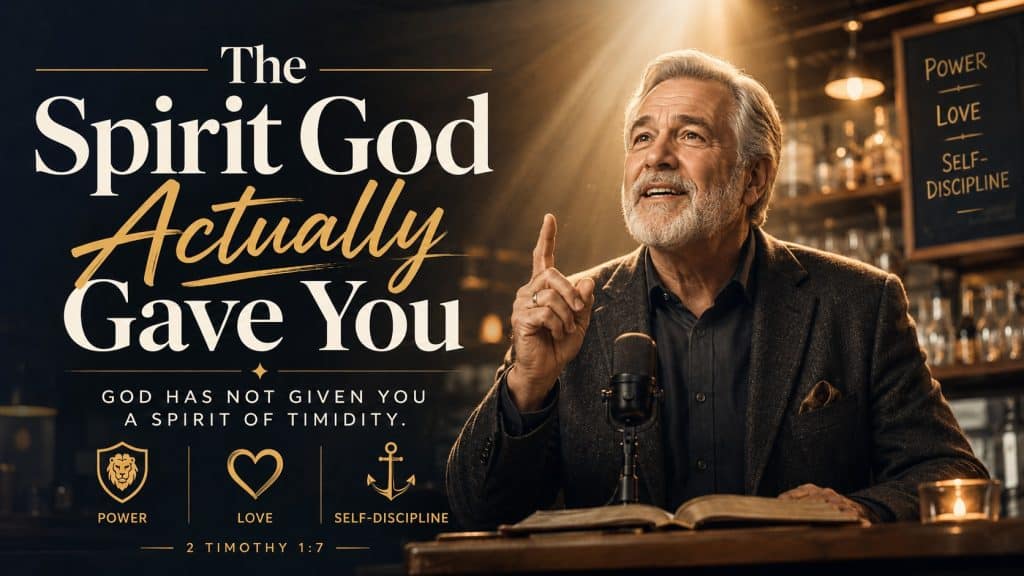
The Spirit God Actually Gave You

July 2, 2026

Preacher speaking passionately about the Holy Spirit and spiritual gifts.

Ben Merold walked into a bar to preach a sermon.

Not exactly how most homiletics professors would recommend you begin your ministry career. But there he was, pulpit replaced by a video machine, cocktail waitresses clattering around in the background. And when he got to the part about the Holy Spirit, everything went quiet. That’s Ben Merold for you. The Word had a way of showing up when he preached it.

I’ve been sitting with a transcript of a sermon Merold preached at the Lincoln Christian College alumni reunion on March 14, 1985. His text was 2 Timothy 1:3-7, and his theme was simple and devastating all at once: God has not given you a spirit of timidity. Whatever that shrinking, fearful, draw-back spirit is that you’re carrying around — you didn’t get it from God.

So where did you get it?

Merold unpacked three things God does give. A spirit of power — not the horsepower kind, but the kind that changes a life, rewires a mind, repairs a relationship. A spirit of love — not the feeling-based, falls-in-and-out variety that fills up divorce court waiting rooms, but the committed, volitional, I’m-showing-up-regardless kind. And finally, a spirit of self-discipline — what Merold called, borrowing from one translation, a smiling mind. Quiet. Steady. Unintimidated by panic or passion.

What strikes me most about this sermon, forty years on, is how thoroughly Merold believed that the Christian life was supposed to be upbeat. He said it plainly: he looked around at Christianity and got a little disgusted at all the people who were down. Joy is fruit of the Spirit. God expects us to express it.

Ben Merold passed away in November 2022 at the age of 96. He grew two churches from under 200 to over 3,000. He held more than 500 revivals. He wanted to be remembered as a church builder and a friend of the small church.

But listening to him preach, what I remember most is that smiling mind.

God gave you that. 

Use it.
On a recent episode of the Better Preaching Podcast, Tyler McKenzie made a confession I suspect most of us preachers could make: comparison nearly stole his love for preaching.

Tyler grew up an athlete, and at first the competitive instinct served him well. He studied great preachers the way a young ballplayer studies Ken Griffey Jr.’s swing — Francis Chan’s passion, Andy Stanley’s conversational ease, Tim Keller’s gift for engaging skeptics. Tyler defends that kind of emulation, and so do I. There is no craft on earth where we wouldn’t tell a rookie to study the greats.

But somewhere along the way, emulation curdled into competition. “I want to be the best preacher of my generation,” he caught himself thinking. “The best preacher in my city.” And the joy began to leak out. He couldn’t walk off stage and savor being used by God. Instead, he cataloged the seven things to fix before the next service. He couldn’t listen to another man’s sermon without keeping score. Pride when he won. Envy when he lost. The man who became a preacher because he loved sermons, the guy who found deep connection to God through sermon preparation, could no longer enjoy delivering one.

Then Tyler told me about the decision that began to break those chains, and it surprised me. He started carrying a manuscript.

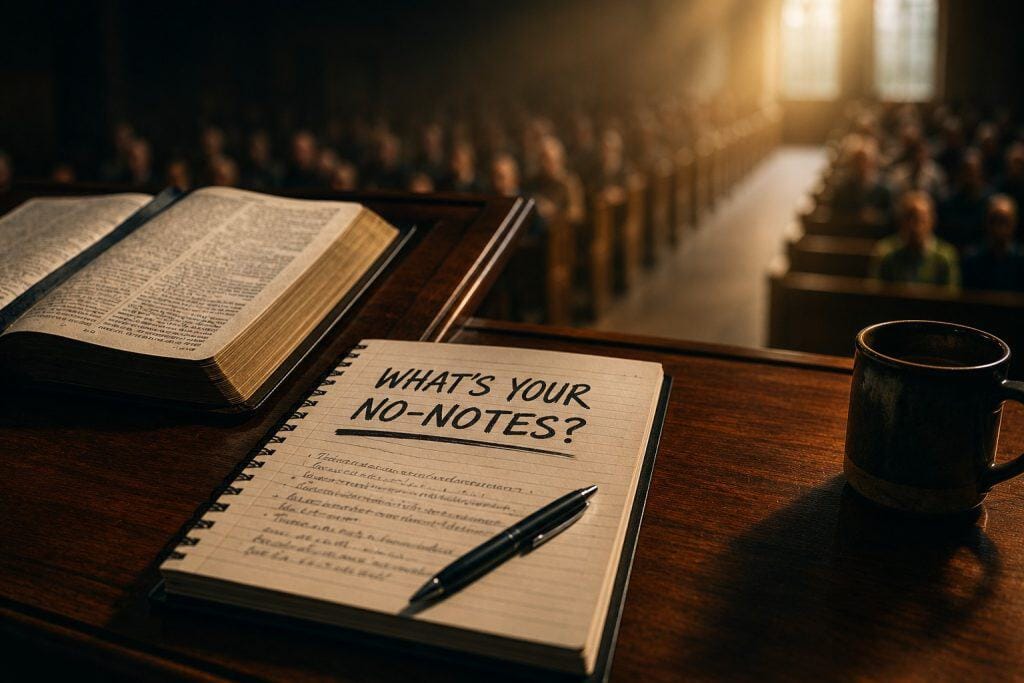
For his first seven or eight years, Tyler was a no-notes preacher. Eventually he admitted he wasn’t doing it because it made his preaching better. He was doing it because he liked what people said about it: “He just goes up there with his Bible and throws it down.” The missing café table most preachers set their notes on became a trophy. So, he humbled himself, wrote a manuscript, and carried it on stage — a small, visible act of surrender declaring this is not about what people think of me. This is about preaching the Word of God. Period.

It also gave him back three hours a week. Humility, it turns out, is efficient.

Teddy Roosevelt usually gets credit for saying “comparison is the thief of joy.” Whoever said it first, every preacher eventually proves it true. Here’s the question I’ve been chewing on since we put the episode in the can: What’s my no-notes? What’s the thing I do in the pulpit not because it serves the Word, but because it serves my reputation?

Find it. Name it. Lay it down.

The joy you get back is worth far more than the applause.

All week long that old Joni Mitchell tune, Both Sides Now has been stuck in my head. This week on the Better Preaching Podcast Nate Ross provided a moment that has made me think: I really don’t know preaching at all.

Nate was two and a half years into leading Northside Christian Church — the church where his father had been lead pastor. The numbers were exactly what any of us would want: twenty percent growth, a twenty-eight-million-dollar campaign successfully raised. And he was miserable.

So he did what most of us do. He pulled levers. He got his preaching calendar a full year out. He built a teaching team with names like Mike Breaux and Efrem Smith on it. Every lever worked. None of them touched the problem. “Everything looks unbelievable,” he told me, “but something is not right in your soul.”

I’ve sat in that chair. Most leaders I know have.

What finally broke it open for Nate wasn’t a better system. It was a question. A counselor asked him to set aside the business model and the branding and answer one thing: what is the Lord doing in your heart? And Nate’s honest answer — “I’d rather help leaders lead their thing than lead my thing” — came out wrapped in shame, because in ministry we’ve absorbed the idea that stepping out of the pulpit is a demotion.

Here’s the framework Nate gave us, and I think it’s worth writing on the inside of your study door. Awareness. Access. Action. Most of us live at the third step and never visit the first two. We take action, take action, take action until the wheels come off and all we’re left with is the awareness that something is badly wrong, with no capacity left to do anything about it.

Nate finds the pattern in Revelation 2. Jesus told the church in Ephesus to “remember” the height from which they’d fallen. Then repent. Then do the things you did at first. Awareness, then access, then action. We keep trying to run the sequence backward.

And underneath all of it is the hardest word in the conversation: undone. Nate describes the deep waters of Proverbs 20:5 the way a diver would: dark, cold, high pressure, nothing you’d enter casually. But he insists that’s where Jesus starts with us. Blessed are the poor in spirit. Blessed are the undone. Judas left because he wouldn’t be undone. Peter kept reaching for a sword because he wouldn’t be undone. We all keep a lever within arm’s reach.

Here’s the earworm that displaced Joni Mitchell rattling around in my head: the best thing you can give your church, and your family, is the healthiest version of you. Not the most impressive version. Not the version that can keep pace with whoever preached that same text better than you did on Sunday.

But that means sitting in a powerless position long enough to let Jesus hold the power. 

Some pastors close out the year with an elaborate written review—pages of reflection, goals, and
spiritual inventory. Chris VandeLinde is not one of those pastors. By his own admission, his
December plan is Christmas Eve, a nap, family, and a lot of sweets. I respect the honesty.

But this past January, Chris—Lead Pastor of Cornerstone Christian Church in Shiloh, Illinois,
and my guest on this week’s Better Preaching Podcast—sat down and prayed a dangerous prayer:
“Lord, how do you need me to lead differently this year?” He’d just taken some hits in December,
the kind that felt personal and unfair, arriving right through the vulnerable chinks in his armor.
The enemy has good aim.

What God gave him fits on a sticky note, which is still stuck to his desk: thicker skin, softer
heart, tighter lips.

Thicker skin. You signed up for this when you said yes to leading a movement that calls
suffering gain. You cannot let an emotional attack from someone with no investment in your life
cost you two days of ministry. Be Elijah on Mount Carmel, not Elijah whimpering under the
broom tree.

Softer heart. Here’s the trap: thicker skin tends to harden the heart right along with it. Chris
insists those two must never run parallel. As the skin toughens, the heart should be softening
toward the broken, the hurting, and the far-from-God. Even the people pushing hardest against
you aren’t your enemy. God’s got a plan for them too. Ezekiel says He replaces hearts of stone
with hearts of flesh. That surgery is ongoing.

Tighter lips. Chris is a verbal processor. His words, though thirty minutes of conversation
confirmed it. God’s correction was simple: some things you work out with Me, not with an
audience. Not every frustration needs to be shared. Some prayers are meant to stay prayers.

I told Chris this sounds like the title of his first book, and I’m only half joking. It preaches.
Because most of us in ministry get the formula exactly backwards: thin skin that bruises at every
criticism, a hardening heart that keeps people at a distance, and loose lips that process every
wound out loud.

God’s order is better. Toughen up. Tender up. Hush up.

That’ll preach in 2026—and every year after.