

When Nice Isn’t Enough

August 20, 2026

Two men exchanging awards on stage at a conference.

I’ve listened to a lot of sermons in my day, and most of them I forget by Tuesday. But every so often a preacher says one sentence that just lodges itself in your chest and won’t leave. Jeff Walling gave us one of those at the 2006 North American Christian Convention, and twenty years later it’s still rattling around in my head: “The time for being nice is over. It’s time to be family.”


Let that sit for a second.


Walling, an a cappella Church of Christ preacher, was standing in front of a room full of Christian Church folks — instruments, praise bands, the whole works — on the hundredth anniversary of the year our two branches of the Restoration Movement got listed as separate religious groups by the U.S. Census Bureau. A hundred years apart, and he had the nerve to say what a lot of us have thought but rarely said out loud: being polite to each other isn’t the finish line. It’s barely the starting block.


He told this story about getting invited to speak at an instrumental youth conference decades earlier. He discovered, after several increasingly awkward phone calls, that “instrumental Church of Christ” was in fact a real thing. That night he sat stone silent on stage while 3,000 teenagers worshiped with a guitar. And somewhere around minute fifteen, watching all that unashamed praise, he realized the problem wasn’t the guitar. It was his own attitude.


That’s the whole sermon in miniature, honestly. Grace doesn’t just save you. It humbles you, it makes you holy, and then it makes you do the hard work of loving people you’ve spent a career keeping at arm’s length. Walling put it more plainly than I could: “It is not duty that drives me to do good. It is how good God has been to me.”
And then — I still get a little misty thinking about this part — he called Dave Stone up on stage, both of them preacher’s kids who’d buried preacher fathers, and traded Bibles with him. Right there in front of everybody. College presidents, seminary heads, worship leaders, all swapping Bibles like it was nothing, when it was actually everything.


I don’t know about you, but I’ve been nice to plenty of people I had no intention of calling family. Walling’s sermon won’t let me get away with that anymore. Nice is easy. Family is a mess. His words, not mine, though I’ve certainly earned the right to borrow them.


You can listen to the whole sermon on The Better Preaching Podcast. And you should. It’s worth every minute.

During March Madness this year, I heard a commentator say something that stuck: Winners want to be coached. I wrote it down because I knew it applied to more than basketball.

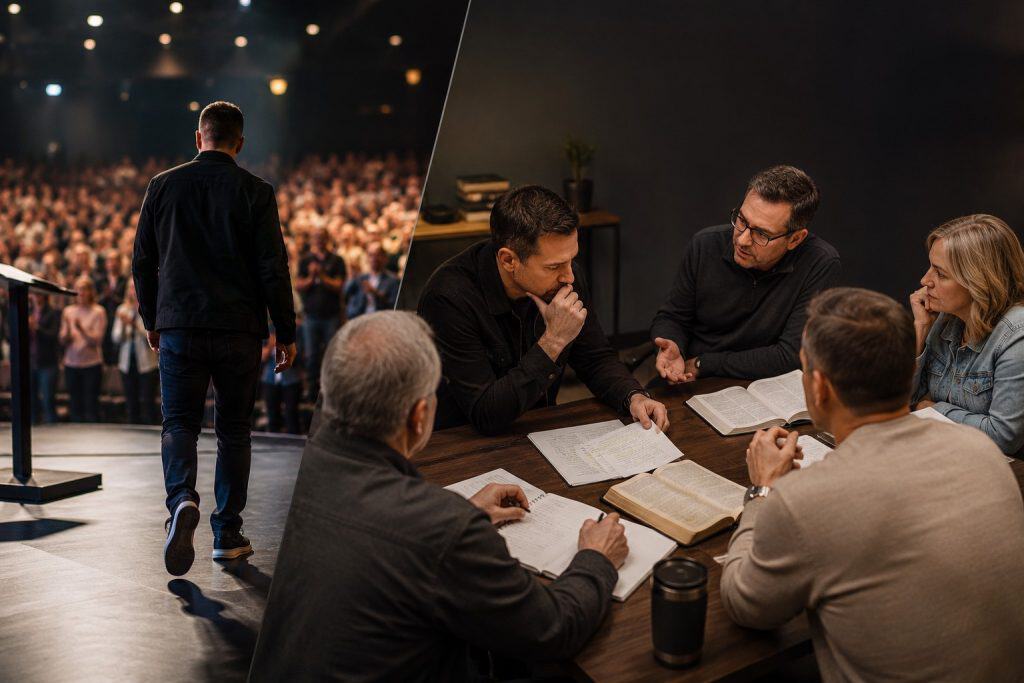
A few days later, I sat down with Don Wilson for the Better Preaching Podcast, and he proved it. Don pastored Christ’s Church of the Valley in Peoria, Arizona, for over three decades, preaching to 25,000 people a week by the time he stepped away. Six live services on a weekend. No executive pastor for most of that run. And the thing that defined his preaching more than any of that was this: every Saturday, he walked off the stage after the four o’clock service, and four or five people followed him into a room and beat his sermon up.

That joke didn’t work. That illustration was too long. Why did you say it that way?

Then it was up to Don to decide what to change before the next service. He did this for years. Not because he was insecure, but because he wanted to get better.

Here’s the part that convicted me. Don said that in his post-ministry years, he’s worked with roughly five hundred pastors. Most of them say they want critique. But when you actually give it to them — when you ask hard questions about why they’re doing what they’re doing — most of them don’t want it at all.

I think he’s right. And I think I know why. Preaching is personal. You pour yourself into a message all week, you stand up and deliver it, and then someone tells you the story ran long or the conclusion fell flat. That hurts. But then again, growth usually hurts.

Don also said something about giving his wife to critique his preaching. He told me: I don’t need a wife who worships me. I need a wife who loves me. He meant that he needs someone honest enough to say, That came across a little judgmental, or You lost them in the middle. Not because she enjoyed saying it, but because he’d created the space for her to say it and she loved him enough to walk into that space.

The green room is comfortable. The critique room is where you get better. Most of us know which one we prefer.

We also know which one we really need.

Every so often a guest says something that rearranges the furniture in my head. Nate Ross did that this week.

Nate spent twenty years in local church ministry before launching Moments to Movements, a leadership development work built on a simple conviction: every leader is stuck or stalled somewhere. Doesn’t matter the size of the church. There is always something you’re wrestling with that you don’t yet know how to name.

Here’s the line that got me. Nate said we are producing a generation of preachers who are good in the pulpit but don’t know how to pastor people. Preaching is a gift, he said, but making disciples is the goal—and gifts exist to serve the goal.

That distinction matters more than we admit. Nate walked me through four areas where leaders need development. Personal performance—the preaching itself—is one of them. But there is also learning agility, relationships, and character. Four, not one.

And here’s the problem I’ve watched play out in churches and, if I’m honest, in higher education too: when someone is exceptional at number one, we give them a pass on the other three. The preaching is strong, attendance is up, the budget is healthy—so nobody asks whether he’s read a book in five years, or whether he can sit in a hospital room, or whether there are cracks in his character that Sunday morning is papering over. Excellence in the visible thing buys silence about the invisible things. That’s not stewardship. That’s a time bomb.

Nate rooted the alternative in something beautiful. He pointed out that Jesus asked 307 questions in the Gospels, and quoted Proverbs 20:5—the purposes of a person’s heart are deep waters, but a person of understanding draws them out. Some of Jesus’ questions sound almost silly on the surface. *Do you want to get well?* The man is obviously lame. But Jesus wasn’t gathering information. He was drawing out deep water.

That’s pastoring. And a preacher who has never learned to do it can still fill a room.

Nate also named the loneliness honestly: we prepare alone, we preach alone, and we recover alone. Then he pointed to John 16, where Jesus tells the disciples they will scatter and leave Him alone—yet He is not alone, because the Father is with Him. Jesus could sit in the loneliness of His calling without needing to escape it. Most of us can’t. So we rush to the next campaign, the next series, the next whiteboard vision.

Sit in the moment instead. Ask the question. Draw out the deep water.

The people in front of you don’t need a better performance. They need a better pastor.

Chris VandeLinde called his air conditioning company last week and spent four minutes talking to a robot before he figured it out. The only giveaway? The robot was a little slow.

Pretty soon it won’t be.

Chris is the Lead Pastor of Cornerstone Christian Church in Shiloh, Illinois, and my guest on this week’s Better Preaching Podcast. He’s no AI alarmist. He told me he uses it every day for research. But he sees something coming that every preacher ought to notice: we are rapidly approaching the day when we can’t trust anything we see or hear online. Was that video real? Did that person actually say that? Am I even talking to a person right now? (For the record, Chris wondered aloud whether he was talking to the real Frank Weller. I assured him I’m one of a kind, which my wife confirms with a sigh.)

Here’s the surprising part. Chris believes this erosion of digital trust is going to drive people back to the things they can know are real. Their neighbors. A circle of chairs. Prayer with actual people in an actual room. Paper Bibles.

And the data backs him up. While AI usage is going through the roof, paper Bible sales are climbing right alongside it. That’s not a coincidence. That’s a hunger. When everything on a screen can be faked, ink on a page starts to feel like solid ground.

Chris thinks we may be standing at the front edge of another golden age of preaching—live proclamation, in person, from a flesh-and-blood preacher people know and trust. I’ve been saying the same thing about Christian higher education. You can learn a lot from a YouTube video. You can ask a chatbot to explain Colossians. But you cannot outsource spiritual formation to a bot, any more than you can outsource physical fitness to a workout video. As Chris put it, at some point you’ve got to actually lift the weights.

Formation happens face to face. It always has. The digital world is about to remind us why.

So preacher, take heart. The very technology that seems to threaten your calling may be the thing that sends people back to your pews, hungry for something real.

That something real is the analog church.

Episode Summary:

In this episode, Dr. Frank Weller talks with Chris VandeLinde, Lead Pastor of Cornerstone Christian Church in Shiloh, Illinois, about preaching that builds culture and reaches the next generation. Chris explains why every sermon must answer questions people are actually asking—especially questions of identity—and why culture-shaping belongs in every message when the average family attends less than twice a month. He shares who taught him to preach, from his youth minister to the podcast preachers who pastored him from afar. A lifelong soccer player, Chris draws a surprising lesson from World Cup culture: the church holds a unifying identity far greater than any flag or team. The conversation closes with his prediction that as AI erodes trust in the digital world, the church will see a resurgence of the tangible: paper Bibles, small groups, and in-person gatherings.

For show notes:

Covenant Connections https://www.covenantconnections.life/