

The Reluctant Preacher and the Power of Routine

June 25, 2026

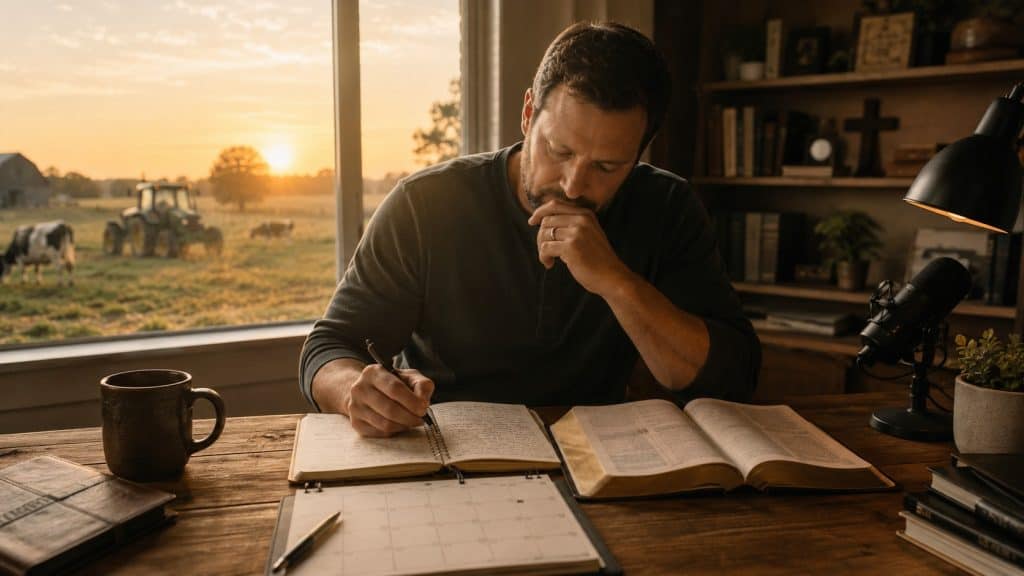
Preacher reading and studying with open Bible at sunset.

Walter Neuenschwander didn’t want to be a preacher.

He wanted to drive a tractor. He wanted to take care of cows. And honestly? When he tells that story, something in it rings true for a lot of people who end up in ministry. The call came early and clear, and he ran from it anyway.

I got to sit down with Walter recently on the Better Preaching Podcast, and what struck me most wasn’t the dramatic Jonah moment where everything turned around (though that’s a great story, and you should listen to the episode). What struck me was something quieter. Something almost boring, in the best possible way.

When I asked Walter what advice he’d give to someone standing where he stood three or four years ago — preaching occasionally, not yet doing it week in and week out — he didn’t say anything flashy. He didn’t talk about charisma or delivery or finding your voice. He said: trust a routine.

Don’t be in a hurry. Start early. Plan ahead. Let the sermon breathe before you have to preach it.

That’s it. That’s the advice.

I’ve been around preaching my whole adult life, and I keep finding that the preachers who last,  the ones who grow, the ones whose congregations are genuinely fed week after week, they all have some version of this. A rhythm. A cadence. A way of living with the text before they have to stand in front of people and open their mouths.

Walter grew up sitting under Ron Fisher who, for decades, taught at Great Lakes Christian College and ministered at Northview Church of Christ. He was a legendary communicator who preached with one hand on the Bible and one hand on the newspaper. Fisher’s influence shaped a generation of ministers across mid-Michigan. And now Walter is doing the same thing at South Lansing Christian Church. Not because he set out to become a preacher, but because he finally stopped running.

God has a habit of doing that. Calling the reluctant. Developing the willing. And apparently, giving them a decent sermon routine in the process.

“And the things you have heard me say in the presence of many witnesses entrust to reliable people who will also be qualified to teach others.” (2 Timothy 2:2)

My Biological Ancestry

My family’s American experience began ten generations ago when my seventh great-grandfather, Johann Jacob Weller, arrived in America in 1737. Four generations later, my third-great grandfather—Johann’s great-great grandson—moved to northeast Indiana. That’s where he and four successive generations of Wellers rest at Cedar Chapel Cemetery. It’s where they’ll lay my bones one day to await Christ’s return.

My Spiritual Ancestry

As fascinated as I am with my family’s genealogy, I am more intrigued with my spiritual family tree. I wish there was a good website for tracing the ancestry of my spiritual fathers and mothers.

I learned about Jesus from my dad, Larry Weller. My childhood preacher, a man named Jim Platner, led my father to faith in Christ. Jim tells me he became a Christian through the influence of, among others, a preacher named Hank McAdams.

That’s as far back as I can trace my spiritual heritage.

If Brother McAdams were still living, I’d be fascinated to find out who told him about Jesus. And who told that person. And the one before.

In eternity I think I’ll have all the time in the world to meet every person in that long line reaching all the way back to Jesus. Jesus discipled Peter, who told Clement about Jesus, who told Ignatius, who told Polycarp, who told Irenaeus, who told someone, who told someone else, all the way down the line to Hank McAdams, Jim Platner, Larry Weller, and eventually me.

Christians Stand in the Middle

That’s because all those folks lived according to 2 Timothy 2:2—“And the things you have heard me say in the presence of many witnesses entrust to reliable people who will also be qualified to teach others.”

If you’re a follower of Jesus, you’re called to stand in the middle between the generation who led you to Christ and people who have not yet become followers of Jesus.

Preachers Stand in the Middle, Too

In 2020 I began meeting with a group of younger preachers for coaching and encouragement. These guys ranged from their late twenties to early thirties, and each were first-time preachers.

By that time, I had been preaching nearly every Sunday for twenty-three years, so I had a lot to say. I’ll leave it to them to decide whether I had much to offer.

We talked about preaching. We explored leading in the context of a complicated time in our nation’s history (remember, it was at the start of the pandemic). Our topics ranged from the mundane—like how to prepare a sermon—to deeply personal subjects like how being in ministry impacted our wives and children.

As I move into my fifties, investing in the next generation of servant leaders feels more important to me than ever.

There was a slogan on the wall of the chapel at the college I attended: “God give us preachers.” This rallying cry is as relevant and needed today as it was forty years ago when I first read it.

It is a prayer, but it is also a reminder that I am the answer to that prayer, because I stand in the middle between the preachers who taught me and the ones who will pick up the mantle of proclaiming God’s Word to a new generation.

Evangelism is the responsibility of every Christian. But it’s important that preachers understand their responsibility to stand in the middle pulpit.

Chris VandeLinde called his air conditioning company last week and spent four minutes talking to a robot before he figured it out. The only giveaway? The robot was a little slow.

Pretty soon it won’t be.

Chris is the Lead Pastor of Cornerstone Christian Church in Shiloh, Illinois, and my guest on this week’s Better Preaching Podcast. He’s no AI alarmist. He told me he uses it every day for research. But he sees something coming that every preacher ought to notice: we are rapidly approaching the day when we can’t trust anything we see or hear online. Was that video real? Did that person actually say that? Am I even talking to a person right now? (For the record, Chris wondered aloud whether he was talking to the real Frank Weller. I assured him I’m one of a kind, which my wife confirms with a sigh.)

Here’s the surprising part. Chris believes this erosion of digital trust is going to drive people back to the things they can know are real. Their neighbors. A circle of chairs. Prayer with actual people in an actual room. Paper Bibles.

And the data backs him up. While AI usage is going through the roof, paper Bible sales are climbing right alongside it. That’s not a coincidence. That’s a hunger. When everything on a screen can be faked, ink on a page starts to feel like solid ground.

Chris thinks we may be standing at the front edge of another golden age of preaching—live proclamation, in person, from a flesh-and-blood preacher people know and trust. I’ve been saying the same thing about Christian higher education. You can learn a lot from a YouTube video. You can ask a chatbot to explain Colossians. But you cannot outsource spiritual formation to a bot, any more than you can outsource physical fitness to a workout video. As Chris put it, at some point you’ve got to actually lift the weights.

Formation happens face to face. It always has. The digital world is about to remind us why.

So preacher, take heart. The very technology that seems to threaten your calling may be the thing that sends people back to your pews, hungry for something real.

That something real is the analog church.

Episode Summary:

In this episode, Dr. Frank Weller talks with Chris VandeLinde, Lead Pastor of Cornerstone Christian Church in Shiloh, Illinois, about preaching that builds culture and reaches the next generation. Chris explains why every sermon must answer questions people are actually asking—especially questions of identity—and why culture-shaping belongs in every message when the average family attends less than twice a month. He shares who taught him to preach, from his youth minister to the podcast preachers who pastored him from afar. A lifelong soccer player, Chris draws a surprising lesson from World Cup culture: the church holds a unifying identity far greater than any flag or team. The conversation closes with his prediction that as AI erodes trust in the digital world, the church will see a resurgence of the tangible: paper Bibles, small groups, and in-person gatherings.

For show notes:

Covenant Connections https://www.covenantconnections.life/

On a recent episode of the Better Preaching Podcast, my guest Mark Christian said something that’s been rattling in my head ever since: “It takes a whole lot more talent to be at a church of 125 than it does to be at a church of over 3,000.”

Mark pastors one of the largest churches in Missouri, but before that he was the pastor of a small church in central Michigan. So, he isn’t romanticizing small-church ministry from the cheap seats. He’s earned the right to say it. Then he went further. He pictured a line forming at heaven’s gates, and the VIP treatment going not to preachers with podcasts and platforms, but to the faithful pastor who served nineteen years in a farm community nobody noticed.

That image stopped me cold. It looks a lot like my dad.

When I was a junior at Great Lakes Christian College, Dad became a freshman. He sold the family farm in his forties and spent the rest of his life as a bivocational preacher in small churches across North Carolina, Georgia, Michigan, Ohio, and Indiana. He called me once, discouraged, thinking about quitting. I asked how many attended the church when he arrived. Twenty. And now? Sixty. He had tripled the church in five years, doing the counseling, the marrying, the burying. And he thought he was failing.

He wasn’t. He just didn’t have a platform to tell him otherwise.

Here’s what I’ve come to believe: a platform is a terrible feedback mechanism. It rewards what photographs well. It has nothing to say about the hospital visit at 2 a.m., the marriage you prayed back from the brink, the funeral where you were the only clergy anyone in that family had ever known, or the teenager who kept showing up because you learned his name. A platform doesn’t measure faithfulness; it only measures reach.

If you’re preaching this Sunday to forty people in a town of four hundred, hear this: the percentage of your community you’re reaching would embarrass most metropolitan megachurches. You are not waiting to be called into ministry. You are already in it.

Summon the heroes. They look like you.