
The Name on the Front of the Jersey

June 4, 2026

Two people shaking hands by water at sunset, symbolizing connection and trust.

In 2006, Dave Stone stepped to the podium at the North American Christian Convention in Louisville, Kentucky. He had just become the lead minister at Southeast Christian Church following Bob Russell’s retirement, a transition that would have rattled most preachers into playing it safe. Stone didn’t play it safe. He preached from Ephesians 4 and asked a room full of church leaders a deceptively simple question: What is the greatest benefit of serving together?

He walked through three answers — unity, maturity, and testimony — and built the case that all three are real, but the last one matters most.

What makes this sermon worth revisiting nearly twenty years later isn’t the exegesis, though the exegesis is solid. It’s the storytelling. Stone understood something every preacher needs to learn: the right story doesn’t just illustrate the point. It becomes the point.

He told about his Uncle Greg, a quadriplegic with cerebral palsy, who went to a camp for developmentally challenged adults. A church member named John Miller volunteered as Greg’s counselor for four days, feeding him, dressing him, even rigging up a flotation device so Greg could swim for the first time in his life. At the end of the week, they asked Greg the standard question: What was your favorite part of camp? Greg raised his arm, pointed at John, and said one word: You.

That story does more theological work than a dozen propositional statements about humble service. And Stone knew it.

He closed with another story, this one from his own childhood. In 1967, his family was hit head-on by a hydroplaning car while on a trip in Illinois. His mother suffered a skull fracture. His father had twenty-one pieces of glass surgically removed from his eyes. Blind and alone in a strange town, the first visitor who took his father’s hand was an elder from a local Church of Christ. When Stone’s father mentioned that his congregation worshipped with instrumental music (a real fault line in the Restoration Movement) the elder said five words that carried the whole sermon home: That doesn’t matter. We just want to help a brother in Christ.

Stone admitted he’d forgotten that elder’s name. Then he landed the plane: I’ve forgotten the name on the back of his jersey, but I’m pretty certain what the name was on the front.

That’s how you close a sermon. You don’t explain the metaphor. You trust it.

Stone trusted it, and the room felt it.

I’ll be honest with you. I’ve been preaching for a while now, and I still walk away from some Sundays thinking, Well, that could have gone better.

There’s no shame in that. In fact, I’d worry about the guy who walks off the platform every week thinking he knocked it clean out of the park. Overconfidence in the pulpit is a little like overconfidence behind the wheel of a tractor — sooner or later, you’re going to end up in a ditch.

I sat down recently with Patrick Lightfoot, lead pastor at Traverse Christian Church in Windsor, Colorado, and something he said stuck with me. He talks about “stage time” — the practice of actually getting up on the platform mid-week and preaching the sermon out loud before Sunday arrives. Not reading it over in your recliner. Not muttering through it in the shower. Actually standing where you stand and speak the words into an empty room.

He calls it “putting in the reps.”

I love that. Because preaching is a craft, and crafts require practice. You don’t sit in the bleachers and become a ball player. You don’t read books about farming and develop a feel for the land. You have to get your hands dirty.

Patrick also talked about watching yourself preach — playing back the recordings and sitting through the awkward “ums” and the rushed transitions and the conclusions that sort of just… trail off. He admits it’s uncomfortable. Of course it is. Nobody enjoys watching themselves on video. I watched one of my sermons once and became briefly convinced that I needed a new career. But that discomfort is where growth hides.

What strikes me most about Patrick’s approach is the discipline underneath the Spirit-dependence. He doesn’t treat those two things as opposites. He plans sermon series a year in advance and still makes room for the Holy Spirit to redirect. He rehearses thoroughly and still steps to the pulpit trusting God, not his notes.

That’s the balance, isn’t it? Preparation isn’t a lack of faith. It’s faithfulness.

Francis Chan puts it in the form of three questions: Am I worried about what God thinks? Do I genuinely love these people? Am I depending on the Holy Spirit?

Patrick has those written on a notecard and tucked in his Bible. They’re a better pre-sermon checklist than anything I could come up with, so I plan to put them in my Bible.

The congregation sitting in front of you every Sunday deserves a preacher who has done the work — and who has also gotten out of the way enough to let God do His.

Put in the reps. Then trust the One who makes them count.

BONUS CONTENT: Here are Francis Chan’s seven questions Patrick Lightfoot mentioned in his recent podcast appearance. Print them off and tuck them in your Bible and see if they don’t shape your preaching.

  1. Am I worried about what people think of my message or what God thinks?—Teach with Fear.
  1. Do I genuinely love these people? — Teach with Love 
  1. Am I accurately presenting this passage? — Teach with Accuracy
  1. Am I depending on the Holy Spirit’s power or my own cleverness? — Teach with Power
  1. Have I applied this message to my own life? — Teach with Integrity 
  1. Will this message draw attention to me or to God? — Teach with Humility 
  1. Do the people really need this message? — Teach with Urgency

Some pastors close out the year with an elaborate written review—pages of reflection, goals, and
spiritual inventory. Chris VandeLinde is not one of those pastors. By his own admission, his
December plan is Christmas Eve, a nap, family, and a lot of sweets. I respect the honesty.

But this past January, Chris—Lead Pastor of Cornerstone Christian Church in Shiloh, Illinois,
and my guest on this week’s Better Preaching Podcast—sat down and prayed a dangerous prayer:
“Lord, how do you need me to lead differently this year?” He’d just taken some hits in December,
the kind that felt personal and unfair, arriving right through the vulnerable chinks in his armor.
The enemy has good aim.

What God gave him fits on a sticky note, which is still stuck to his desk: thicker skin, softer
heart, tighter lips.

Thicker skin. You signed up for this when you said yes to leading a movement that calls
suffering gain. You cannot let an emotional attack from someone with no investment in your life
cost you two days of ministry. Be Elijah on Mount Carmel, not Elijah whimpering under the
broom tree.

Softer heart. Here’s the trap: thicker skin tends to harden the heart right along with it. Chris
insists those two must never run parallel. As the skin toughens, the heart should be softening
toward the broken, the hurting, and the far-from-God. Even the people pushing hardest against
you aren’t your enemy. God’s got a plan for them too. Ezekiel says He replaces hearts of stone
with hearts of flesh. That surgery is ongoing.

Tighter lips. Chris is a verbal processor. His words, though thirty minutes of conversation
confirmed it. God’s correction was simple: some things you work out with Me, not with an
audience. Not every frustration needs to be shared. Some prayers are meant to stay prayers.

I told Chris this sounds like the title of his first book, and I’m only half joking. It preaches.
Because most of us in ministry get the formula exactly backwards: thin skin that bruises at every
criticism, a hardening heart that keeps people at a distance, and loose lips that process every
wound out loud.

God’s order is better. Toughen up. Tender up. Hush up.

That’ll preach in 2026—and every year after.

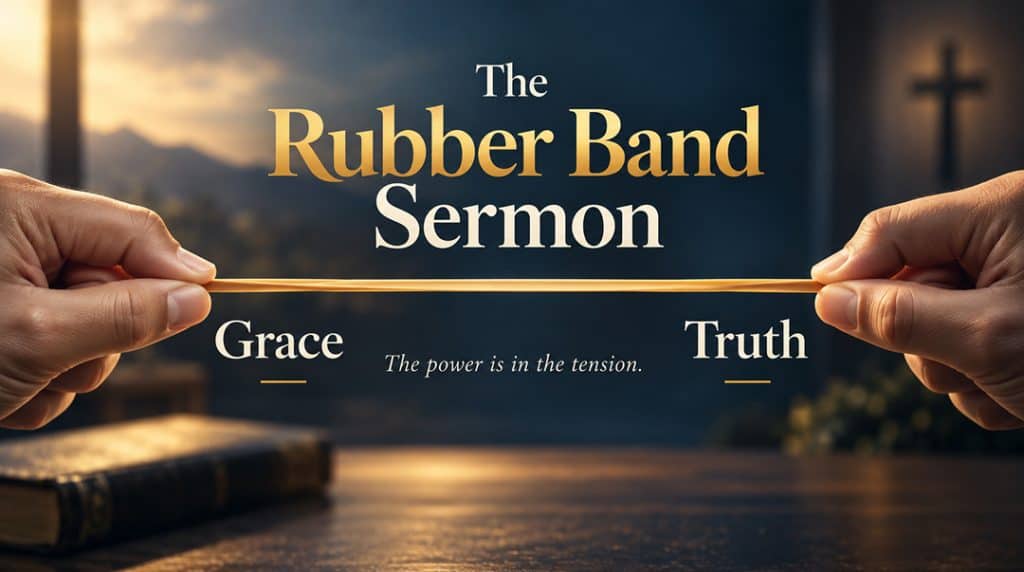
A rubber band lying on your desk is useless. It has no power, no purpose, no strength. The only time a rubber band accomplishes anything is when it’s stretched—held in tension between two opposite poles.

That’s grace and truth.

Ron Otto and I got into this on the latest episode of the Better Preaching Podcast, and it may be my favorite stretch of conversation we’ve ever recorded. Ron, who is closing in on twenty years at Lincoln Christian Church, observed that Jesus often opens with grace and closes with truth. I pushed back gently—with the woman at the well, He led with truth: five husbands, and the man you’re with now isn’t one of them. The honest answer is that it depends on the person and the moment, and knowing which to lead with is one of the hardest judgment calls in ministry.

But here’s what you can’t do: let go of either end.

Hold the rubber band and release truth, and it snaps you—that sting is called hedonism. Hold truth and release grace, and it snaps you from the other side—that sting is called legalism. The power is only in the tension. So is the pain-free path, oddly enough. You have to hold both ends.

Ron told a story that shows what holding both looks like. He ends nearly every service by telling his congregation he loves them—not as a signoff, but because he means it. One Sunday he forgot. A young woman stopped him at the door and pointed it out. When he asked if she needed to hear it, she said, “Most Sundays you’re the only one to tell me that for a whole week.”

Let that settle in, preacher. For some of your people, you are the only voice of love they hear from Sunday to Sunday.

And here’s the ministry math Ron has learned over three decades: you can get away with preaching a lot of hard truths if your people know first that you love them. Truth without love sounds angry. Love without truth goes mushy. But truth wrapped in love—delivered by a shepherd who says “I love you” and means it—that’s the stretched rubber band. That’s where the power is.

Now go tell your church you love them. Some of them are waiting.

Because better preaching makes a bigger impact.