
Putting in the Reps

April 16, 2026

Two men smiling during a podcast interview, one with headphones and the other with glasses.

I’ll be honest with you. I’ve been preaching for a while now, and I still walk away from some Sundays thinking, Well, that could have gone better.

There’s no shame in that. In fact, I’d worry about the guy who walks off the platform every week thinking he knocked it clean out of the park. Overconfidence in the pulpit is a little like overconfidence behind the wheel of a tractor — sooner or later, you’re going to end up in a ditch.

I sat down recently with Patrick Lightfoot, lead pastor at Traverse Christian Church in Windsor, Colorado, and something he said stuck with me. He talks about “stage time” — the practice of actually getting up on the platform mid-week and preaching the sermon out loud before Sunday arrives. Not reading it over in your recliner. Not muttering through it in the shower. Actually standing where you stand and speak the words into an empty room.

He calls it “putting in the reps.”

I love that. Because preaching is a craft, and crafts require practice. You don’t sit in the bleachers and become a ball player. You don’t read books about farming and develop a feel for the land. You have to get your hands dirty.

Patrick also talked about watching yourself preach — playing back the recordings and sitting through the awkward “ums” and the rushed transitions and the conclusions that sort of just… trail off. He admits it’s uncomfortable. Of course it is. Nobody enjoys watching themselves on video. I watched one of my sermons once and became briefly convinced that I needed a new career. But that discomfort is where growth hides.

What strikes me most about Patrick’s approach is the discipline underneath the Spirit-dependence. He doesn’t treat those two things as opposites. He plans sermon series a year in advance and still makes room for the Holy Spirit to redirect. He rehearses thoroughly and still steps to the pulpit trusting God, not his notes.

That’s the balance, isn’t it? Preparation isn’t a lack of faith. It’s faithfulness.

Francis Chan puts it in the form of three questions: Am I worried about what God thinks? Do I genuinely love these people? Am I depending on the Holy Spirit?

Patrick has those written on a notecard and tucked in his Bible. They’re a better pre-sermon checklist than anything I could come up with, so I plan to put them in my Bible.

The congregation sitting in front of you every Sunday deserves a preacher who has done the work — and who has also gotten out of the way enough to let God do His.

Put in the reps. Then trust the One who makes them count.

BONUS CONTENT: Here are Francis Chan’s seven questions Patrick Lightfoot mentioned in his recent podcast appearance. Print them off and tuck them in your Bible and see if they don’t shape your preaching.

  1. Am I worried about what people think of my message or what God thinks?—Teach with Fear.
  1. Do I genuinely love these people? — Teach with Love 
  1. Am I accurately presenting this passage? — Teach with Accuracy
  1. Am I depending on the Holy Spirit’s power or my own cleverness? — Teach with Power
  1. Have I applied this message to my own life? — Teach with Integrity 
  1. Will this message draw attention to me or to God? — Teach with Humility 
  1. Do the people really need this message? — Teach with Urgency
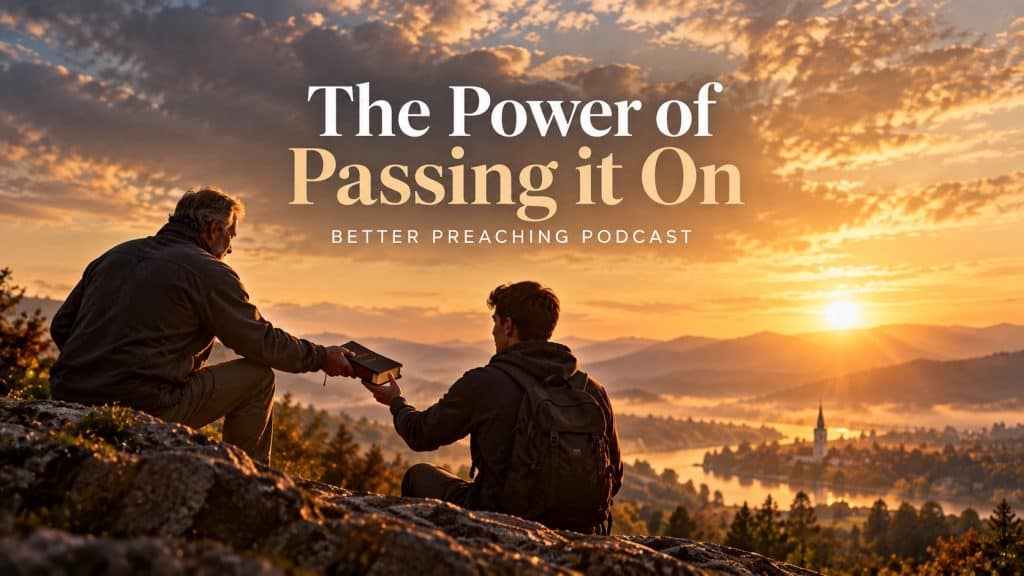
One of the verses I’ve preached on repeatedly is 2 Timothy 2:2: “And the things you have heard me say in the presence of many witnesses entrust to reliable people who will also be qualified to teach others.” The beauty of this verse isn’t just in what it asks us to do, it’s in the posture it demands. We must stand in the middle.

Dave Stone’s journey at Southeast Christian Church perfectly illustrates this principle. For seventeen years, he served as Bob Russell’s associate, learning the craft of preaching, the discipline of pastoral care, the practice of leadership, and the art of sharing the pulpit. Then, for thirteen years, he led as Senior Pastor, embodying everything Bob taught him while adding his own voice and gifts. Now, he’s watching Kyle Idleman live out that same role — a lineage of faithful, long-tenured leadership spanning decades.

What struck me most in our conversation was Dave’s honesty about what he learned from Bob versus what he’s learned from Kyle. “I’ve learned more from Kyle than I ever passed on to him,” Dave admitted. This is the humility that characterizes genuine mentorship. We don’t hand down our way as the final word; we create space for the next generation to stretch us, challenge us, and sometimes do it better.

Bob made space for Dave by doing something unheard of in large churches: he shared the spotlight. He gave Dave tough sermon topics, not easy ones. He let Dave preach Easter. He threw him in the deep end because he believed Dave could handle it. And Dave, in turn, did the same for Kyle. But here’s what moved me most: when I asked Dave what he’d tell his younger self, he didn’t talk about avoiding hard things or playing it safe. He talked about relying on the Holy Spirit rather than the flesh. He acknowledged that he’d been betrayed, that problems would come, but that these experiences drove him — as it should all of us — deeper into dependence on God’s Spirit, not away from ministry.

This is what standing in the middle actually means. It’s not just transferring information from one generation to the next. It’s creating a culture where we expect growth, demand honesty, embrace humility, and ultimately point people toward the Holy Spirit’s power rather than our own competence. At Great Lakes Christian College, we’re trying to build this kind of generational faithfulness. Our students stand in the middle too, between the faith their parents gave them and the faith they’ll pass on to their children. And our job is to help them learn that authentic ministry doesn’t come from mastering technique alone. It comes from learning to stand still and let the Spirit work.

That’s worth passing on.

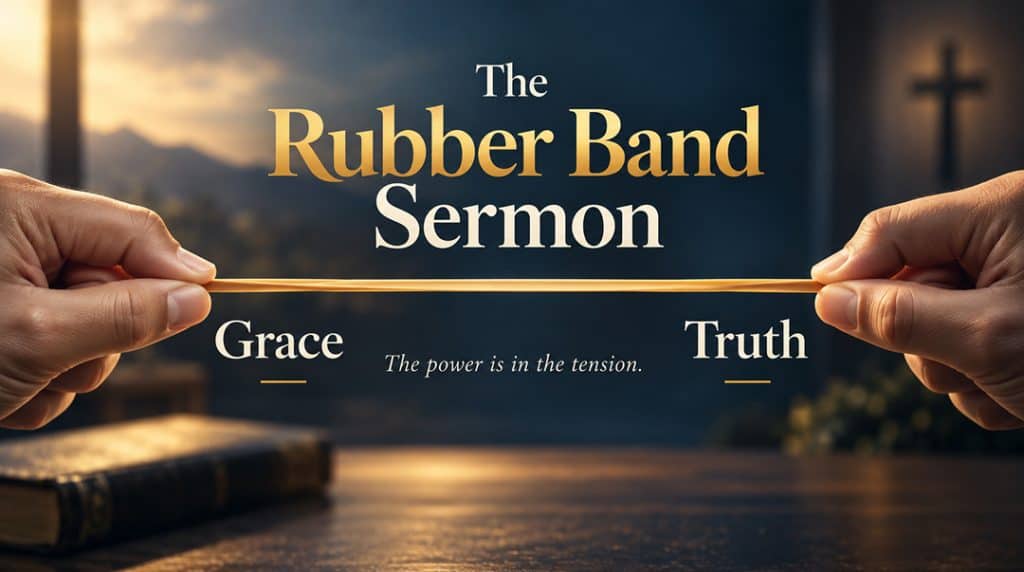
A rubber band lying on your desk is useless. It has no power, no purpose, no strength. The only time a rubber band accomplishes anything is when it’s stretched—held in tension between two opposite poles.

That’s grace and truth.

Ron Otto and I got into this on the latest episode of the Better Preaching Podcast, and it may be my favorite stretch of conversation we’ve ever recorded. Ron, who is closing in on twenty years at Lincoln Christian Church, observed that Jesus often opens with grace and closes with truth. I pushed back gently—with the woman at the well, He led with truth: five husbands, and the man you’re with now isn’t one of them. The honest answer is that it depends on the person and the moment, and knowing which to lead with is one of the hardest judgment calls in ministry.

But here’s what you can’t do: let go of either end.

Hold the rubber band and release truth, and it snaps you—that sting is called hedonism. Hold truth and release grace, and it snaps you from the other side—that sting is called legalism. The power is only in the tension. So is the pain-free path, oddly enough. You have to hold both ends.

Ron told a story that shows what holding both looks like. He ends nearly every service by telling his congregation he loves them—not as a signoff, but because he means it. One Sunday he forgot. A young woman stopped him at the door and pointed it out. When he asked if she needed to hear it, she said, “Most Sundays you’re the only one to tell me that for a whole week.”

Let that settle in, preacher. For some of your people, you are the only voice of love they hear from Sunday to Sunday.

And here’s the ministry math Ron has learned over three decades: you can get away with preaching a lot of hard truths if your people know first that you love them. Truth without love sounds angry. Love without truth goes mushy. But truth wrapped in love—delivered by a shepherd who says “I love you” and means it—that’s the stretched rubber band. That’s where the power is.

Now go tell your church you love them. Some of them are waiting.

Because better preaching makes a bigger impact.

In the fall of 2016, yard signs started popping up all over Lincoln, Illinois. One neighbor had a Trump sign. Another had a Hillary sign. And squeezed between them, on lawn after lawn: “Jesus. Period.”

People assumed it was a political statement. It was actually a sermon series.

Ron Otto, my guest on this week’s Better Preaching Podcast, has preached at Lincoln Christian Church for almost twenty years—the longest preaching tenure in that church’s history. And those signs announced the most audacious thing he’s ever attempted from the pulpit: an eighteen-month journey through the entire Gospel of Luke, starting one December and ending two Easters later. He told his congregation, “Your pastor’s doing this because he’s courageous.” Then he did it. The church’s highest average attendance came during that series.

Why did it work? Ron credits a cassette tape.

Years ago, somebody handed him a recording of Fred Craddock teaching on what he called the nod of recognition and the shock of recognition. Craddock’s warning to young preachers went something like this: in our rush to say something nobody’s ever heard before, we hunt for obscure passages and clever angles—and we steal from our people the joy of the nod. That moment when a listener leans back and thinks, “I know this story. This is one of the stories of Jesus.”

But the nod is only half the sermon. The shock of recognition comes when the listener suddenly realizes the story is about them. They’re not observing the prodigal son from a safe distance. They’re standing in the far country holding the pig slop.

I’ve heard it put another way: every sermon needs amen moments and aha moments. The amen is the nod. The aha is the shock. Preaching that’s all nod is comfortable and forgettable. Preaching that’s all shock is clever and exhausting. But when familiar texts suddenly turn and look your people in the eye—that’s when the Word does its work.

So here’s the encouragement, preacher: you don’t need obscure passages to be profound. Ron seldom goes looking for them. Preach the stories your people already know, and trust God to spring the trap.

Eighteen months in Luke. Yard signs in an election year. A congregation nodding along—right up until the story turned and shocked them.

Jesus. Period.

Because better preaching makes a bigger impact.