

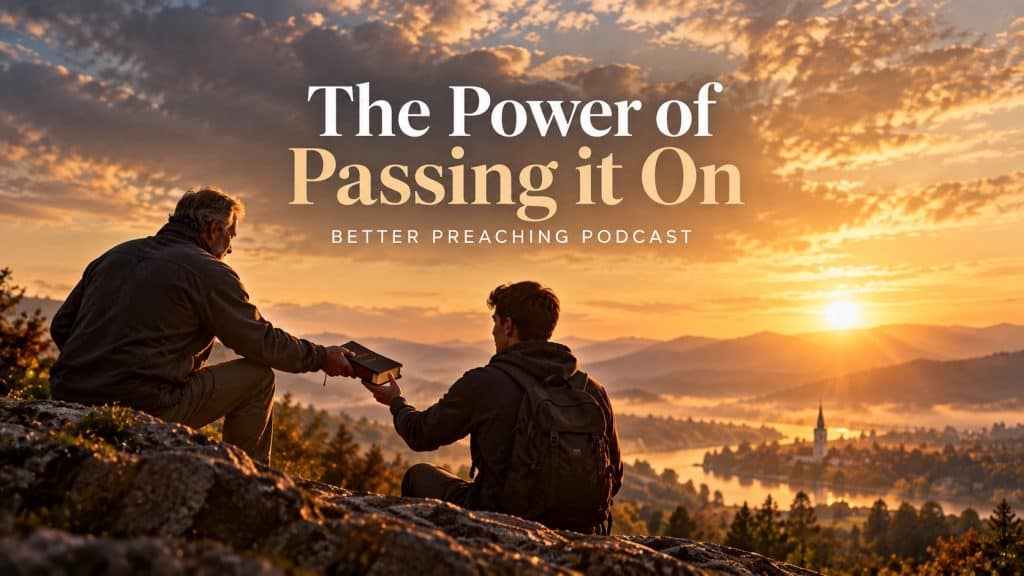
The Power of Passing it On

October 1, 2026

One of the verses I’ve preached on repeatedly is 2 Timothy 2:2: “And the things you have heard me say in the presence of many witnesses entrust to reliable people who will also be qualified to teach others.” The beauty of this verse isn’t just in what it asks us to do, it’s in the posture it demands. We must stand in the middle.

Dave Stone’s journey at Southeast Christian Church perfectly illustrates this principle. For seventeen years, he served as Bob Russell’s associate, learning the craft of preaching, the discipline of pastoral care, the practice of leadership, and the art of sharing the pulpit. Then, for thirteen years, he led as Senior Pastor, embodying everything Bob taught him while adding his own voice and gifts. Now, he’s watching Kyle Idleman live out that same role — a lineage of faithful, long-tenured leadership spanning decades.

What struck me most in our conversation was Dave’s honesty about what he learned from Bob versus what he’s learned from Kyle. “I’ve learned more from Kyle than I ever passed on to him,” Dave admitted. This is the humility that characterizes genuine mentorship. We don’t hand down our way as the final word; we create space for the next generation to stretch us, challenge us, and sometimes do it better.

Bob made space for Dave by doing something unheard of in large churches: he shared the spotlight. He gave Dave tough sermon topics, not easy ones. He let Dave preach Easter. He threw him in the deep end because he believed Dave could handle it. And Dave, in turn, did the same for Kyle. But here’s what moved me most: when I asked Dave what he’d tell his younger self, he didn’t talk about avoiding hard things or playing it safe. He talked about relying on the Holy Spirit rather than the flesh. He acknowledged that he’d been betrayed, that problems would come, but that these experiences drove him — as it should all of us — deeper into dependence on God’s Spirit, not away from ministry.

This is what standing in the middle actually means. It’s not just transferring information from one generation to the next. It’s creating a culture where we expect growth, demand honesty, embrace humility, and ultimately point people toward the Holy Spirit’s power rather than our own competence. At Great Lakes Christian College, we’re trying to build this kind of generational faithfulness. Our students stand in the middle too, between the faith their parents gave them and the faith they’ll pass on to their children. And our job is to help them learn that authentic ministry doesn’t come from mastering technique alone. It comes from learning to stand still and let the Spirit work.

That’s worth passing on.
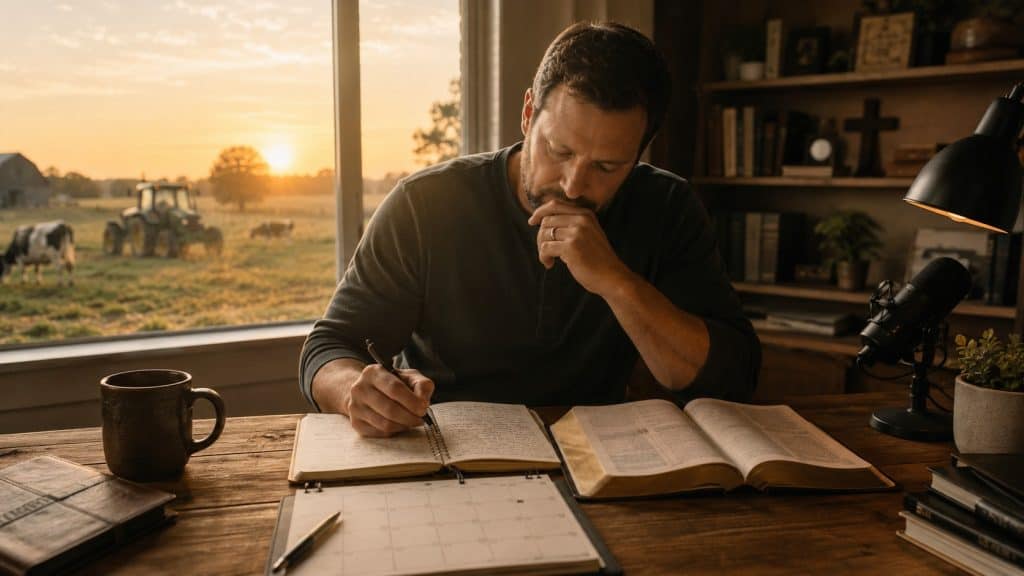
Walter Neuenschwander didn’t want to be a preacher.

He wanted to drive a tractor. He wanted to take care of cows. And honestly? When he tells that story, something in it rings true for a lot of people who end up in ministry. The call came early and clear, and he ran from it anyway.

I got to sit down with Walter recently on the Better Preaching Podcast, and what struck me most wasn’t the dramatic Jonah moment where everything turned around (though that’s a great story, and you should listen to the episode). What struck me was something quieter. Something almost boring, in the best possible way.

When I asked Walter what advice he’d give to someone standing where he stood three or four years ago — preaching occasionally, not yet doing it week in and week out — he didn’t say anything flashy. He didn’t talk about charisma or delivery or finding your voice. He said: trust a routine.

Don’t be in a hurry. Start early. Plan ahead. Let the sermon breathe before you have to preach it.

That’s it. That’s the advice.

I’ve been around preaching my whole adult life, and I keep finding that the preachers who last,  the ones who grow, the ones whose congregations are genuinely fed week after week, they all have some version of this. A rhythm. A cadence. A way of living with the text before they have to stand in front of people and open their mouths.

Walter grew up sitting under Ron Fisher who, for decades, taught at Great Lakes Christian College and ministered at Northview Church of Christ. He was a legendary communicator who preached with one hand on the Bible and one hand on the newspaper. Fisher’s influence shaped a generation of ministers across mid-Michigan. And now Walter is doing the same thing at South Lansing Christian Church. Not because he set out to become a preacher, but because he finally stopped running.

God has a habit of doing that. Calling the reluctant. Developing the willing. And apparently, giving them a decent sermon routine in the process.

All week long that old Joni Mitchell tune, Both Sides Now has been stuck in my head. This week on the Better Preaching Podcast Nate Ross provided a moment that has made me think: I really don’t know preaching at all.

Nate was two and a half years into leading Northside Christian Church — the church where his father had been lead pastor. The numbers were exactly what any of us would want: twenty percent growth, a twenty-eight-million-dollar campaign successfully raised. And he was miserable.

So he did what most of us do. He pulled levers. He got his preaching calendar a full year out. He built a teaching team with names like Mike Breaux and Efrem Smith on it. Every lever worked. None of them touched the problem. “Everything looks unbelievable,” he told me, “but something is not right in your soul.”

I’ve sat in that chair. Most leaders I know have.

What finally broke it open for Nate wasn’t a better system. It was a question. A counselor asked him to set aside the business model and the branding and answer one thing: what is the Lord doing in your heart? And Nate’s honest answer — “I’d rather help leaders lead their thing than lead my thing” — came out wrapped in shame, because in ministry we’ve absorbed the idea that stepping out of the pulpit is a demotion.

Here’s the framework Nate gave us, and I think it’s worth writing on the inside of your study door. Awareness. Access. Action. Most of us live at the third step and never visit the first two. We take action, take action, take action until the wheels come off and all we’re left with is the awareness that something is badly wrong, with no capacity left to do anything about it.

Nate finds the pattern in Revelation 2. Jesus told the church in Ephesus to “remember” the height from which they’d fallen. Then repent. Then do the things you did at first. Awareness, then access, then action. We keep trying to run the sequence backward.

And underneath all of it is the hardest word in the conversation: undone. Nate describes the deep waters of Proverbs 20:5 the way a diver would: dark, cold, high pressure, nothing you’d enter casually. But he insists that’s where Jesus starts with us. Blessed are the poor in spirit. Blessed are the undone. Judas left because he wouldn’t be undone. Peter kept reaching for a sword because he wouldn’t be undone. We all keep a lever within arm’s reach.

Here’s the earworm that displaced Joni Mitchell rattling around in my head: the best thing you can give your church, and your family, is the healthiest version of you. Not the most impressive version. Not the version that can keep pace with whoever preached that same text better than you did on Sunday.

But that means sitting in a powerless position long enough to let Jesus hold the power. 

Tony Johnson was back on the podcast this week, and he said something in the first five minutes that I haven’t stopped thinking about: “I was preparing for a different style of preaching than what is natural for me.” He was preaching based on the way he prepared, rather than preparing for the way that he preaches. Read that twice. I had to.

Tony told me he used to build these meticulous outlines — detailed enough that he could hand them to someone else and they could preach the message. But when he got up to preach, he wasn’t using the outline at all. He was following the red circles and blue stars he’d scribbled on it. The notes were theater. The real preparation was happening somewhere else entirely.

So he blew it up and started over, building a process that matches how his brain works. Mondays through Wednesdays, he just lives in the passage: reading it, praying over it, letting it marinate. No writing. He calls this white space, and he’s convinced it’s one of the most underused tools in a preacher’s kit. Some of his best material shows up at two in the morning on a trip to the bathroom, not at a desk with a deadline looming. Thursday, he sits down and builds a mind map, breaking the message into four or five movements he can hold in his head rather than a manuscript he has to follow. Less prep time. More authenticity. A sermon that feels discovered rather than delivered.

Now, Tony’s got a teaching team of five to seven preachers to coordinate, which most of us reading this don’t have. But don’t let that get in the way of the real point. If you’re the only voice at a church of 125, you can still build a team around your preparation, even if you’re the only one standing up on Sunday. Ask a few trusted voices in your congregation what they think people need to hear. Let your spouse hear you talk about something you love and compare that energy to your preaching voice. Tony’s litmus test was simple: are you performative, or are you proclaiming something that’s naturally been embedded in you?

He also mentioned something that stuck with me. 2|42 has moved away from Tony underlining scripture on a screen when he preaches and gone back to him simply holding a Bible in his hand. No graphics, no bumpers, just him, the text, and the room. Turns out people aren’t as hungry for polish as they are the Word.

Find the process that fits how God wired you. Then get out of your own way.

Better preaching makes a bigger impact.

Episode Summary

Discover how preacher Tony Johnson transforms his approach to sermon preparation, emphasizing authenticity and responsiveness. Learn practical tips on adapting your preaching style, engaging your congregation, and cultivating your unique voice.