
What’s Your No-Notes?

June 18, 2026

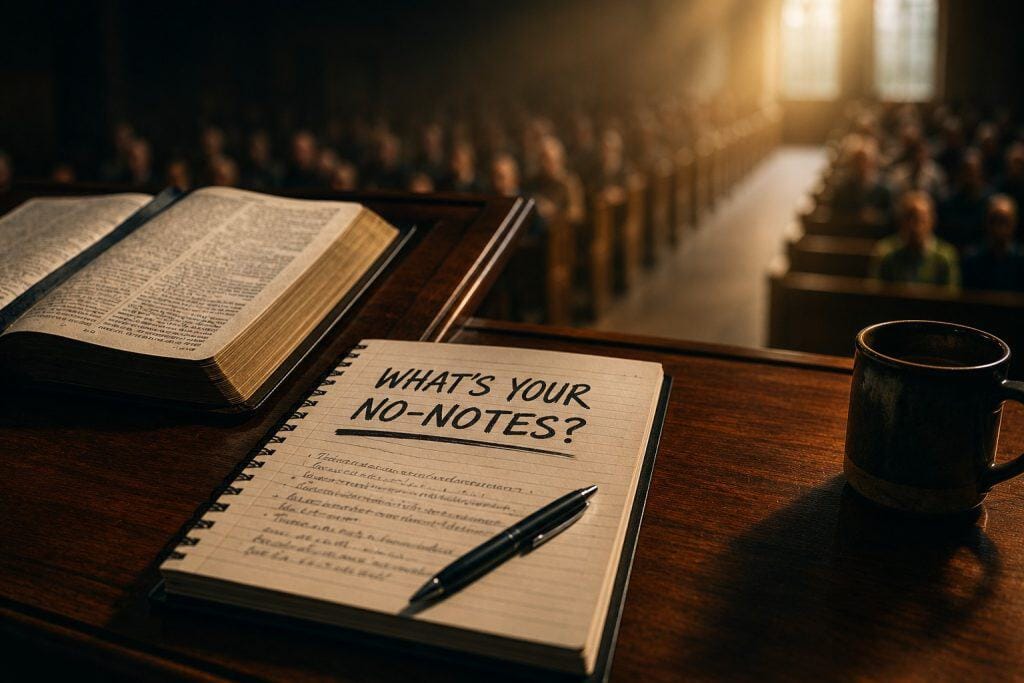
Open notebook with 'What's Your No-Notes?' question in a church setting.

On a recent episode of the Better Preaching Podcast, Tyler McKenzie made a confession I suspect most of us preachers could make: comparison nearly stole his love for preaching.

Tyler grew up an athlete, and at first the competitive instinct served him well. He studied great preachers the way a young ballplayer studies Ken Griffey Jr.’s swing — Francis Chan’s passion, Andy Stanley’s conversational ease, Tim Keller’s gift for engaging skeptics. Tyler defends that kind of emulation, and so do I. There is no craft on earth where we wouldn’t tell a rookie to study the greats.

But somewhere along the way, emulation curdled into competition. “I want to be the best preacher of my generation,” he caught himself thinking. “The best preacher in my city.” And the joy began to leak out. He couldn’t walk off stage and savor being used by God. Instead, he cataloged the seven things to fix before the next service. He couldn’t listen to another man’s sermon without keeping score. Pride when he won. Envy when he lost. The man who became a preacher because he loved sermons, the guy who found deep connection to God through sermon preparation, could no longer enjoy delivering one.

Then Tyler told me about the decision that began to break those chains, and it surprised me. He started carrying a manuscript.

For his first seven or eight years, Tyler was a no-notes preacher. Eventually he admitted he wasn’t doing it because it made his preaching better. He was doing it because he liked what people said about it: “He just goes up there with his Bible and throws it down.” The missing café table most preachers set their notes on became a trophy. So, he humbled himself, wrote a manuscript, and carried it on stage — a small, visible act of surrender declaring this is not about what people think of me. This is about preaching the Word of God. Period.

It also gave him back three hours a week. Humility, it turns out, is efficient.

Teddy Roosevelt usually gets credit for saying “comparison is the thief of joy.” Whoever said it first, every preacher eventually proves it true. Here’s the question I’ve been chewing on since we put the episode in the can: What’s my no-notes? What’s the thing I do in the pulpit not because it serves the Word, but because it serves my reputation?

Find it. Name it. Lay it down.

The joy you get back is worth far more than the applause.
Last week I had the privilege of sitting down with Dave Stone, and our conversation reminded me of something we desperately need to remember in this moment: artificial intelligence will never be able to do what a pastor can do.

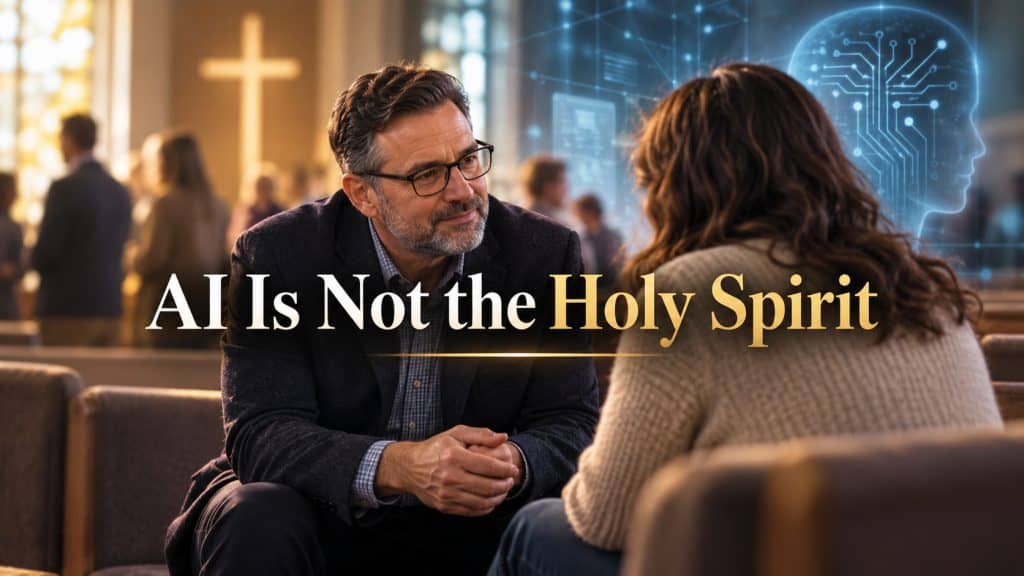
Dave shared something profound during our time together: “AI is not the Holy Spirit.” It sounds obvious when you say it out loud, but in a season when AI tools are proliferating faster than we can evaluate them, this statement cuts through all the noise. Yes, AI can help us edit our sermons. Yes, it can assist with wordsmithing and refining our language. But it cannot do the thing that makes preaching actually matter: it cannot connect a human soul with the living God.

This distinction became even clearer when Dave mentioned research showing that loneliness and companionship rank among the top uses of AI. Think about that. People are turning to artificial intelligence for what they should be finding in community. In the church. This isn’t a failure of AI; if anything, it is a misuse of AI. Dave’s warning is a clarion call for the church to lean into what we uniquely offer: genuine, Spirit-empowered presence.

At Great Lakes Christian College, we’ve built our entire institutional identity around this conviction. We know that spiritual formation cannot happen through a screen, no matter how sophisticated the technology. It happens when a student sits in a professor’s office and feels truly known. It happens when suitemates gather around someone who’s grieving and offer the kind of comfort that only the presence of another person can provide. It happens when a visiting speaker takes the time to learn students’ names and genuinely invests in their lives.

Dave spoke beautifully about something he did when he was Senior Minister of Southeast Christian Church. Dave would stand at the escalator to greet latecomers — not to shame them for showing up late, but to learn their names, to notice the visitor who feels out of place, to make the sanctuary feel smaller and more personal. He was describing something that AI could never replicate: the pastoral presence that says, “You matter. I see you. I know your name.”

The irony is that by distinguishing ourselves from AI, by leaning into what technology cannot do, we’re actually making our institutions and churches more relevant, not less. In a world drowning in information and connection-less connectivity, people are hungry for the real thing.

So yes, let’s use AI wisely. But let’s never mistake tools for transformation. Let’s never outsource spiritual formation to a machine. And let’s keep doing what only humans empowered by the Holy Spirit can do: see people, know their names, and love them into the Kingdom.

I recently sat down with Ben Cachiaras for the Better Preaching Podcast. Ben has served Mountain Christian Church near Baltimore for thirty of its 201 years, and I wanted to hear how a kid from Rochester, Minnesota ended up giving his life to preaching.

He almost didn’t.

Rochester is home to the Mayo Clinic, and Ben grew up surrounded by doctors’ kids. He was bright. School came easily. Plenty of people told him medicine would be a noble path, and he was leaning that way. Then he went to church camp.

Pine Haven Christian Assembly sits on a Minnesota lake where Ben had been baptized years earlier. That weekend, the preacher in the hot little chapel was Ben’s grandfather—a Greek immigrant who came to Christ at Johnson Bible College in the early 1900s and served Minnesota Bible College from 1919 until his death in 1983. Picture it: folding chairs, restless high schoolers, and a nearly ninety-year-old man preaching with the passion of someone half his age.

At the end, he gave an invitation to salvation, and a couple of kids came forward. But he wasn’t finished. He issued a second call, for anyone willing to give the best energy of their life to serving the local church. To be a preacher. Then he added the line that undid his grandson: “If you think to yourself, ‘Yeah, I could probably do that,’ I’m not talking to you. I’m talking to the one who knows you can’t do anything else and have peace with God.”

Ben melted. He walked the aisle crying, stood beside his grandfather, and repeated a confession the old man composed on the spot. Med school was over before it started. He enrolled at Minnesota Bible College, and the trajectory of his life bent toward the pulpit for good.

Looking back, Ben suspects his grandfather knew exactly who was sitting in those folding chairs that day. I suspect he’s right.

Here’s what stayed with me. Ben said that moment makes him want to grab every seventh, eighth, and tenth grader, look them in the eye, and tell them it’s not too early to think about ministry. I grew up hearing my preacher say the best and brightest of our generation should go to Bible college and enter the ministry, the highest calling any of us can pursue.

Somewhere along the way, many of our churches went quiet on that. We tell our sharpest students to pursue engineering or medicine, and those are noble callings. But somebody has to say what Ben’s grandfather said.

Who’s the kid in your congregation waiting for a bold, clear call?

Say it. They may be listening harder than you think.

Early in ministry, I mistook volume for fruit. If the room was full, the sermon must have worked. If the stage was bigger, the calling must be clearer. It took me years to see I had the equation backwards.


Mark Christian drew a helpful distinction in a recent conversation on the Better Preaching Podcast: there is performative preaching, and there is pastoral preaching. Performative preaching walks onto a stage, earns the right to say a big thing, and says it well. It has its place. Camp messages, conferences, funerals for people you barely knew. Someone has to stand up and speak. We need preachers who can do that. But most of us aren’t called to live there.


Pastoral preaching is the slow work of opening the same Scriptures to the same people over a long stretch of years. It is not lesser work. It is harder in a different way. You can’t hide behind cleverness when the people in the pew watched you make coffee at their mother’s funeral. You can’t fake authority with a congregation that knows your kids’ names and has seen you on your worst Monday. You have to actually pastor, and the pulpit becomes less a performance stage and more a kitchen table where the family gathers to hear from the Book.


Here’s what I’ve learned: the preacher who stays gets something the traveling evangelist never will. You see the sermon land and then watch it grow. You preach on forgiveness in May and sit across from a reconciled father and daughter in October. You preach on generosity in November and watch the benevolence fund fill up by January. You preach a hard word on pride, and three families thank you for it six months later. That feedback loop shapes your preaching in ways no homiletics textbook can.


If you’re in year two or year twelve, and you’re tempted to think the real preaching is happening somewhere else, don’t believe it. Stay. Preach the text. Love the people. Let the Holy Spirit do the slow work.