

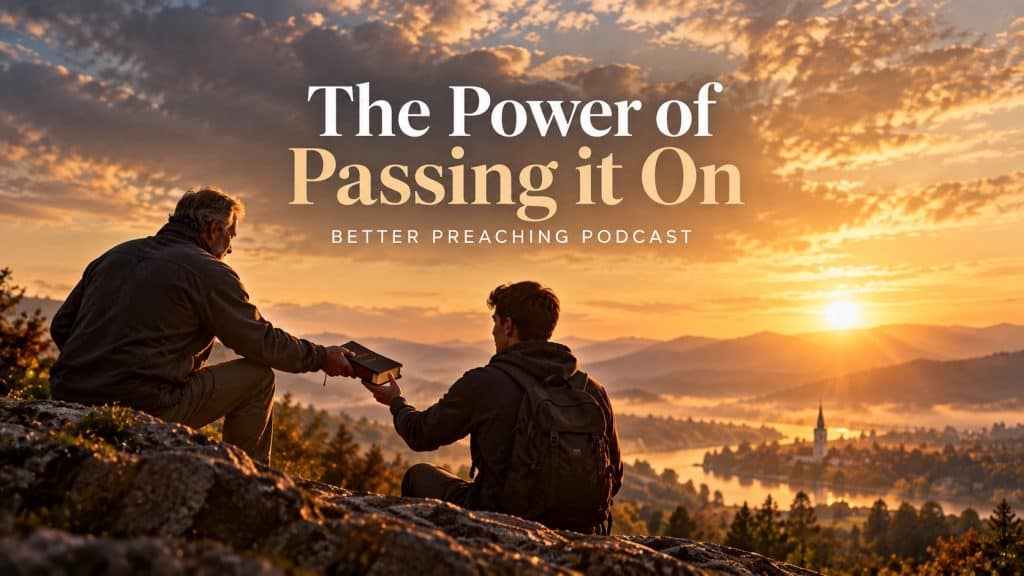
The Power of Passing it On

October 1, 2026

One of the verses I’ve preached on repeatedly is 2 Timothy 2:2: “And the things you have heard me say in the presence of many witnesses entrust to reliable people who will also be qualified to teach others.” The beauty of this verse isn’t just in what it asks us to do, it’s in the posture it demands. We must stand in the middle.

Dave Stone’s journey at Southeast Christian Church perfectly illustrates this principle. For seventeen years, he served as Bob Russell’s associate, learning the craft of preaching, the discipline of pastoral care, the practice of leadership, and the art of sharing the pulpit. Then, for thirteen years, he led as Senior Pastor, embodying everything Bob taught him while adding his own voice and gifts. Now, he’s watching Kyle Idleman live out that same role — a lineage of faithful, long-tenured leadership spanning decades.

What struck me most in our conversation was Dave’s honesty about what he learned from Bob versus what he’s learned from Kyle. “I’ve learned more from Kyle than I ever passed on to him,” Dave admitted. This is the humility that characterizes genuine mentorship. We don’t hand down our way as the final word; we create space for the next generation to stretch us, challenge us, and sometimes do it better.

Bob made space for Dave by doing something unheard of in large churches: he shared the spotlight. He gave Dave tough sermon topics, not easy ones. He let Dave preach Easter. He threw him in the deep end because he believed Dave could handle it. And Dave, in turn, did the same for Kyle. But here’s what moved me most: when I asked Dave what he’d tell his younger self, he didn’t talk about avoiding hard things or playing it safe. He talked about relying on the Holy Spirit rather than the flesh. He acknowledged that he’d been betrayed, that problems would come, but that these experiences drove him — as it should all of us — deeper into dependence on God’s Spirit, not away from ministry.

This is what standing in the middle actually means. It’s not just transferring information from one generation to the next. It’s creating a culture where we expect growth, demand honesty, embrace humility, and ultimately point people toward the Holy Spirit’s power rather than our own competence. At Great Lakes Christian College, we’re trying to build this kind of generational faithfulness. Our students stand in the middle too, between the faith their parents gave them and the faith they’ll pass on to their children. And our job is to help them learn that authentic ministry doesn’t come from mastering technique alone. It comes from learning to stand still and let the Spirit work.

That’s worth passing on.

Building Authentic Relationships for Deeper Impact

Effective preaching goes beyond delivering messages from the pulpit—it requires cultivating genuine relationships with the congregation. This is part two of a five-part series of posts that explore principles to help you preach contextualized sermons to people who are different than you.

This principle focuses on the importance of intentionally connecting as a generational immigrant so you can foster the trust and relatability that are necessary to increase the impact of your sermons.

The Challenge of Generational Distance

As pastors age, they can soon discover they are significantly older than many in their churches. Even when the congregation grows older with their pastor, the future of the church depends on it growing younger.

When there is a generational gap between the preacher and the congregation, it can inadvertently create barriers where younger parishioners feel misunderstood or distant from their pastors. The clergy–laity boundaries many practiced in the past can be off-putting for younger members.

What It Means to Intentionally Connect

Intentional connection means making an active effort to engage younger or older generational cohorts in ways that acknowledge their unique perspectives and needs.

It involves lowering traditional boundaries, being approachable, and demonstrating genuine care.

Practical Ways to Build Connection

Here is a truism: the more connected the congregation feels to their preacher, the more receptive they are likely to be to his preaching.

Here are four ways preachers can build connections that will result in more effective preaching:

  • Be accessible: Simple gestures like being visible in church lobbies or responding to social media interactions show availability and interest.
  • Share vulnerabilities: When pastors are appropriately transparent about their own struggles and failures, it builds authenticity and trust.
  • Engage beyond Sunday: Investing time in mentoring, attending social events, or hosting informal gatherings helps build deeper relationships.
  • Say “yes” more often: Affirming and encouraging younger generational cohorts by saying “yes” to prayer requests or meetings can have profound positive effects. The book Growing Young by Powell, Mulder, and Griffin is especially helpful on this point.

The Payoff of Connection

When younger Christians feel genuinely known and supported by their pastors, they are more open to hearing challenging biblical truths.

Relatability increases receptivity, making preaching a collaborative journey rather than a one-sided lecture.

Pastors need to remember that ministry is as much about being present and connected as it is about the content of sermons.

On a recent Better Preaching Podcast episode, I asked Mark Christian for his parting word to preachers. He didn’t hesitate: “Let the text win. Let it win in you. Stand underneath it before you ever stand behind the pulpit.”

I haven’t been able to shake that line.

Let’s be honest; most of us don’t approach the text to lose. But we do approach the text to mine it. We come armed with an outline, a sermon slot, a series title already on the church app, and we start interrogating the passage to get it to confess what we need it to say by Sunday. The text becomes a witness we’ve subpoenaed. We’re the attorney. We ask the questions. We decide which answers make the cut.

That’s not preaching. That’s prosecuting.

Letting the text win is a different posture entirely. It means showing up on Tuesday without a predetermined verdict. It means reading slowly enough so the text has time to read you back. It means allowing the passage to ruin your first three ideas before it gives you the right one. It means getting uncomfortable in your own conscience before you ever figure out how to make your congregation uncomfortable in theirs.

You can’t fake this. Your people can tell the difference between a preacher who has wrestled with the text and a preacher who has merely researched it. The wrestled preacher limps a little. There’s a weight in his voice that commentary software cannot manufacture. He isn’t delivering information. He’s delivering testimony.

Here’s the ordering Mark got exactly right: underneath, then behind. If you haven’t stood underneath the text all week, you have no business standing behind the pulpit on Sunday. The pulpit doesn’t confer authority on your words. The text does. And the text only confers that authority on preachers who have been willing, privately, to be defeated by it.

This week, let it win. Let it corner you. Let it convict you before it comforts your people. Let it strip you of the clever turn of phrase you already had written in the margin. Let it hand you a harder word than you were hoping for.

Then, and only then, stand up and preach.