
More Important How You Finish

September 20, 2026

Runner finishing race at sunset with inspiring message about finishing strong.

Ask Ron Otto for his all-time favorite preaching point and he doesn’t hesitate: it’s more important how you finish than how you start.

He’s earned the right to say it. On this week’s Better Preaching Podcast, Ron — nearly twenty years into his ministry at Lincoln Christian Church — told me about his rough start. He was a poor student who didn’t think ministry was even possible for him. It took the grace of God and the grace of a lot of people, he says, including some grace from Great Lakes Christian College, to get him through. His dad taught him roofing so he’d always have a trade to fall back on, but God had other plans for those hands.

And Ron is right about the pattern. Scripture repeats it on nearly every page. Consider the demon-possessed man living among the tombs. You cannot script a rougher start than that. But when Jesus restores him, He doesn’t hide him away. He commissions him to go tell everybody what the Lord has done for you. Ron calls that story a snapshot of his own life.

I tell every student who visits my office the same thing: at Great Lakes, we’re concerned about where you’re at, but we’re more concerned about where you’re going. Your trajectory matters more than your location.

But here’s where Ron pressed the point further, and it’s the part that stuck with me. Starting well isn’t the finish line. Finishing well is the finish line. Ron is 65 now. His words: “I’m in the last leg of my race. This is my last lap.” And his singular ambition for that lap is two words he’s shared with his elders and asked them to hold his feet to: finish strong.

Because we’ve all watched too many talented preachers stumble before the tape. Blown-up marriages. Blown-up families. Blown-up churches. Satan hates whatever God loves — the church, the Word, marriage — and he doubles down on preachers. The gifting that got you into the pulpit will not keep you standing in it. Only vigilance, humility, and leaders with permission to hold you accountable will do that.

So, wherever you are on the track — rough start, strong start, middle miles, or final lap — lift your eyes to the finish line. Grace covers how you started. Faithfulness determines how you’ll finish.

Set your heart to finish strong.

Because better preaching makes a bigger impact.  

Preachers have beautiful feet. You read that correctly. Before your thoughts turn to hammer toes and plantar warts, consider this: Scripture agrees with me. Paul quoted Isaiah to the church in Rome, “As it is written: How beautiful are the feet of those who bring good news!” (Romans 10:15)

He was talking about preachers. In the verse just before his podiatric metaphor Paul wrote, “How, then, can they call on the one they have not believed in? And how can they believe in the one of whom they have not heard? And how can they hear without someone preaching to them? And how can anyone preach unless they are sent?” (Romans 10:14–15)

Paul was thinking specifically of his Jewish brothers and sisters in this text. Despite his calling as the Apostle to the Gentiles, Paul began the chapter declaring “my heart’s desire and prayer to God for the Israelites is that they may be saved.”

The Evangelical Imperative for Preaching

God’s heart still breaks for the lost. Even though some think preaching is foolish business (1 Corinthians 1:18–21), God still wants everyone to be saved and understand the truth (1 Timothy 2:4). How does God do that? Through preaching.

Charles Spurgeon, one of England’s greatest preachers, credited a sermon he heard on Isaiah 45:22—“Young man, look to Jesus Christ”—for becoming a Christian when he was 15 years old.

Louis Zamperini was a hero and World War II prisoner of war. In 1949 he attended a Billy Graham crusade in Los Angeles where Graham’s sermon on forgiveness and salvation led him to surrender his life to Christ. He went on to forgive and reconcile with his former captors and became an evangelist himself.

Johnny Cash was addicted to pills and booze and even though he grew up in a Christian family had walked away from God. It was gospel preaching that led him to rededicate his life and shape his public witness as a Christian artist.

Introducing the Better Preaching Podcast

God loves the lost—and preaching leads them home. That’s why we began the Better Preaching Podcast. Better preaching helps more people find the God who loves them.

The Better Preaching Podcast is founded on four assumptions:

  • Preaching matters – God uses preaching to change lives. (Romans 10:14–15)
  • Better preaching – One can become a better preacher. (2 Timothy 2:15; 4:1–3)
  • We’re better together – Learning from the past leads to the future. (Jeremiah 6:16)
  • Great sermons are timeless. (Psalm 119:1–5)

My Story

It was a long list of preachers who changed my life. I learned about Jesus from my father, Larry Weller. He became a Christian because of the preaching and witness of a minister named Jim Platner. Jim became a Christian through the influence of preachers like Hank McAdams.

I’m not only a preacher because of this spiritual ancestry, but I am a better preacher because of the example of preachers like Dr. Gary Carpenter, Bob Russell, and many others.

Lost people matter. So preach like it.

The Better Preaching Podcast can help.

During March Madness this year, I heard a commentator say something that stuck: Winners want to be coached. I wrote it down because I knew it applied to more than basketball.

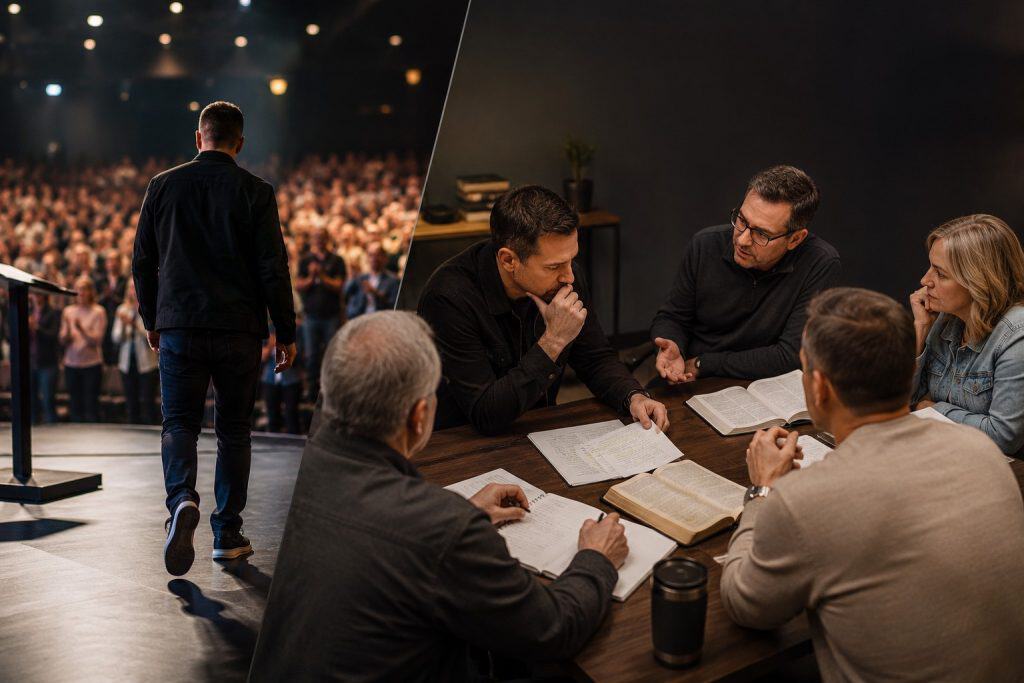
A few days later, I sat down with Don Wilson for the Better Preaching Podcast, and he proved it. Don pastored Christ’s Church of the Valley in Peoria, Arizona, for over three decades, preaching to 25,000 people a week by the time he stepped away. Six live services on a weekend. No executive pastor for most of that run. And the thing that defined his preaching more than any of that was this: every Saturday, he walked off the stage after the four o’clock service, and four or five people followed him into a room and beat his sermon up.

That joke didn’t work. That illustration was too long. Why did you say it that way?

Then it was up to Don to decide what to change before the next service. He did this for years. Not because he was insecure, but because he wanted to get better.

Here’s the part that convicted me. Don said that in his post-ministry years, he’s worked with roughly five hundred pastors. Most of them say they want critique. But when you actually give it to them — when you ask hard questions about why they’re doing what they’re doing — most of them don’t want it at all.

I think he’s right. And I think I know why. Preaching is personal. You pour yourself into a message all week, you stand up and deliver it, and then someone tells you the story ran long or the conclusion fell flat. That hurts. But then again, growth usually hurts.

Don also said something about giving his wife to critique his preaching. He told me: I don’t need a wife who worships me. I need a wife who loves me. He meant that he needs someone honest enough to say, That came across a little judgmental, or You lost them in the middle. Not because she enjoyed saying it, but because he’d created the space for her to say it and she loved him enough to walk into that space.

The green room is comfortable. The critique room is where you get better. Most of us know which one we prefer.

We also know which one we really need.

Nobody warned Walter Neuenschwander that the panic was coming.
But somebody warned me. Early in my preaching life, a seasoned minister told a room full of young preachers that one day that, probably about a year into full-time ministry, you’re going to show up on a Monday morning and think you’ve got nothing left. You’ve preached everything you know. The cupboard is bare.
Walter heard the same warning in seminary. And by the grace of God, neither of us ever hit that wall. Here’s why: process.
The idea is simple, even if the discipline isn’t. Get six weeks ahead of your Sunday sermon. It starts with knowing your preaching calendar a year out. Then, when you’re six weeks from a given message, start writing. Put something on paper. Let it marinate. Then pick it up the week before you preach it, edit it, talk through it — literally out loud, multiple times — and then step into the pulpit.
That’s it. That’s the secret.
I know what you’re thinking. Six weeks ahead? That’s impossible. It felt that way to me once too. But here’s the advice that cracked it open for me, borrowed from Andy Stanley’s Communicating for a Change: don’t try to get six weeks ahead. Just try to get one week ahead. Write the sermon you plan to preach in two weeks first. Then write the sermon you plan to preach in two days. Do that for six weeks and suddenly you’re there.
And what you get on the other side is something preachers rarely talk about: your Saturdays back. Your family back. The margin to handle a funeral, a crisis, a season where life throws fifteen curveballs in three months, without your Sunday sermon being the thing that suffers.
Walter put it well. When you’re six weeks out, you’re not panicking. And when you’re not panicking, you’re not just surviving until Sunday. You’re actually thinking. Crafting. Letting a sermon breathe before you have to breathe life into it from a pulpit.
Ministry is a long game. The preachers who last are almost always the ones who learned to stop running behind and start running ahead.
Six weeks out is a great place to be.